1

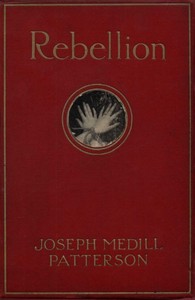
Rebellion — Themes and Context
24
3
Project Gutenberg
2018
Married women -- Fiction; Chicago (Ill.) -- Fiction; Catholics -- Fiction; Divorce -- Fiction
Readers of public-domain and historical texts
Project Gutenberg digital edition
en
Edition facts
Words: 63,743
Reading time: 278 min
Text sections: 6
Source:
Project Gutenberg record #56455
An editorial note on Joseph Medill Patterson's 1911 novel 'Rebellion,' focusing on its narrative voice, shifts in pace, and use of dialogue and interiority, based on excerpts from the Project Gutenberg text.
Joseph Medill Patterson's Rebellion opens with a scene of masculine camaraderie in a bar, where the protagonist Jim Connor negotiates a single drink with his peers. The dialogue is clipped, the bartender's movements are described with mechanical precision, and the clock ticks overhead. This initial pace is unhurried, almost ritualistic, establishing a world of social codes and unspoken rules. Yet within a few pages, the narrative accelerates into a private dinner with Georgia, where Jim's internal conflict between secrecy and confession drives a more anxious, introspective rhythm. The contrast between these two modes—public performance and private tension—shapes the novel's early movement.
Dialogue as Social Currency
The barroom exchange in Chapter I is built on shorthand: “Nope, promised to be home on time for supper.” “Get panned last night!” “Yep.” These lines are not merely functional; they signal a shared vocabulary among men who measure time by drinks and obligations. The narrator lingers on the bartender’s “delicate touch” and the ritual of toasts (“Here’s whatever,” “Happy days”). This is a world where speech is economical, almost performative. Later, when Jim dines with Georgia, the dialogue becomes more expansive but also more fraught. He “babbled on” about his opportunity, unable to stop despite Silverman’s injunction to silence. The narrator notes that “it had become physically impossible for him to lie to her,” a shift from the guarded bar talk to a confession that feels compelled. The contrast highlights how the novel uses dialogue to mark different social spheres—public bravado versus intimate vulnerability.
Interiority and the Weight of Silence
Patterson frequently dips into Jim’s thoughts, but the excerpts show a narrator who reports internal states with a dry, almost ironic distance. When Jim watches Georgia’s train depart, the narration gives us “He said ‘Hell,’ lit a cigar, pushed his hat back, sighed and went to check his trunk.” The actions are external, but the single expletive and the sequence of gestures imply frustration and resignation. Earlier, Jim’s internal monologue during dinner is rendered as a kind of self-justification: “he passed on the ever heavy load of silence, hoping that she could hold her tongue if he couldn’t.” The narrator does not dwell on emotion; instead, the pace quickens through accumulation of detail. This technique creates a sense of urgency beneath the surface calm, as Jim’s unspoken fears—about his secret, about Georgia’s indifference—press against the narrative.
Shifts in Pace and Narrative Focus
The excerpts reveal a novel that alternates between leisurely description and compressed action. The opening bar scene unfolds in real time, with each drink order and toast recorded. But when Jim and Georgia part, the narrative jumps: “it was all over for a much longer time than he had any idea of.” The sentence telescopes forward, hinting at future events without specifying them. Similarly, the transition from dinner to the train platform is abrupt, with the narrator summarizing Jim’s journey in a single paragraph: “He sat up in the smoking compartment gassing with drummers … sympathized for awhile with the Pullman porter.” This compression creates a sense of momentum, as if the story is accelerating toward an unknown crisis. The novel’s structure—with chapters titled “Triangulation,” “Fusion,” and “Rebellion”—suggests that these shifts in pace are deliberate, marking turning points in Jim’s trajectory.
Readers should attend to how Patterson uses the rhythm of conversation and silence to chart Jim Connor’s inner life. The barroom rituals and the dinner table confessions are not just setting; they are the medium through which the novel explores loyalty, secrecy, and the pressures of marriage. The excerpts offer only a partial view, but they suggest a work that is as interested in what is left unsaid as in what is spoken. Watch for how the narrative voice modulates between the clipped, masculine world of the opening and the more introspective passages that follow.
Reader reflection
Your personal reading reflection
Build a private reading journal entry for this title.
Your progress
0
/
10
2
How did the book work for you overall?
3
How likely are you to recommend this book?
4
What was the reading difficulty like?
5
What did you think about the pace?
6
Did the book meet your expectations?
7
Could you see yourself revisiting this book?
8
Would you start a conversation about this book?
9
What did this book teach you most?
10