1

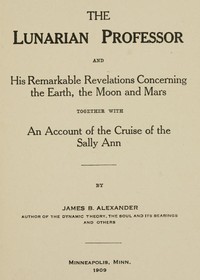
The Lunarian Professor and His Remarkable Revelations Concerning the Earth, the Moon and Mars Together with An Account of the Cruise of the Sally Ann — Key Ideas to Explore
36
7
Project Gutenberg
2019
Utopias -- Fiction; Human-alien encounters -- Fiction; Life on other planets -- Fiction
Readers of public-domain and historical texts
Project Gutenberg digital edition
en
Edition facts
Words: 83,563
Reading time: 364 min
Text sections: 7
Source:
Project Gutenberg record #60059
A 1909 novel in which a Lunarian professor visits Earth in 1892, delivering predictions about population, technology, and society, framed by a preface that playfully questions the authority of prophetic utterances.
Editorial Edition Score
4.7/5
★★★★★
★★★★★
Calculated from edition completeness, EPUB availability, text structure and catalogue metadata. Not a user rating.
Edition quality
The preface immediately establishes a skeptical tone: the author notes the visit occurred in 1892, seventeen years before publication, and admits some predictions—like Minneapolis reaching 1,780,000 by 1925—already seem improbable. Yet he refuses to alter the professor's utterances, wryly comparing acceptance of the professor's errors to accepting biblical dicta when the speakers 'do not know what they are talking about.' This framing invites readers to treat the ensuing revelations as both earnest speculation and ironic performance.
A Frame of Doubt and Authority
The preface does more than apologize for inaccuracies; it establishes a layered narrative stance. The author claims he is 'not prepared to aver that the truths as they appear to common mundane mortals are to be preferred to the errors however manifest of so illustrious a prophet.' This rhetorical move—comparing the Lunarian to Moses or St. Paul—undermines the very authority it invokes. The reader is left to decide whether the professor's revelations are visionary or absurd. The preface also introduces a key structural device: the visit is set in the past, so some predictions are already testable. The author's refusal to 'alter the Professional utterances' preserves the text as a historical document of futurology, not a corrected forecast.
Population Arithmetic and Synthetic Food
In the excerpted dialogue, the professor and narrator debate Earth's carrying capacity. The professor calculates that by 2070, 12 billion people could each have two acres of habitable land. The narrator objects that two acres is insufficient for food, timber, and fiber. The professor counters by describing Lunarian methods of artificial food production from soil and rock directly, bypassing agriculture. He dismisses the narrator's concern as 'only thinking of the crude methods people had in your day.' This exchange reveals the novel's method: it uses concrete numbers and technological extrapolation to challenge Malthusian limits. The professor's confidence in chemical synthesis reflects early 20th-century faith in science, while the narrator's skepticism grounds the debate in practical constraints.
The Profile of Time and Prophetic Calculation
The professor's 'Profile of Time' is a recurring image—a visual or conceptual timeline on which he marks population milestones. In the excerpt, he pulls out 'a pencil of curious make' and 'with his middle left hand dashed off some strange looking characters on a blank space on the profile.' This gesture emphasizes the alien nature of Lunarian cognition: left-handed, using unfamiliar symbols, performing rapid calculations. The profile itself becomes a structural motif, linking the novel's many predictions—from population to political divisions to flying machines. It suggests that time is a measurable, graphable entity, and that prophecy is a matter of reading the right chart. The narrator's role is to question the assumptions behind the numbers, keeping the reader engaged in the arithmetic.
Movement Between Scenes: From Outing to Orbit
The table of contents reveals a rapid shift from mundane settings—'An Outing,' 'An Old Time Adventure,' 'Cruise of the Sally Ann'—to cosmic topics: 'The Moon and Its People,' 'Mars and the Martians.' The narrative moves from a terrestrial cruise to interplanetary travel, then to extended lectures on social reform (Single Tax, Woman's Rights, Socialism) and futuristic technology (Flying Machines, Sun Power). This structure mirrors the professor's own movement between worlds: he is a visitor who brings alien perspectives to earthly debates. The final chapters return to the voyage, with 'The Return Voyage' and an appendix, suggesting a circular journey. The reader is carried along as a passenger, shifting from adventure to treatise and back.
Readers should approach this work as a hybrid: part travel narrative, part speculative essay, part satire of prophetic certainty. The preface's ironic tone invites critical reading of the professor's claims, while the detailed predictions reward attention to the logic—and illogic—of futurology. The novel's value lies not in accuracy but in its snapshot of early 1900s anxieties about population, technology, and social change, filtered through an alien lens.
Reader reflection
What did you think of this book?
Answer a few questions and save a private reflection on this device.
Your progress
0
/
10
2
How much did you enjoy the reading experience?
3
Would you encourage someone else to read it?
4
How easy was the book to follow?
5
Which aspect of the book did you value most?
6
How strongly did the book affect you emotionally?
7
How useful did the reading feel?
8
Did any part of the book feel personally relevant?
9
Which lesson or insight stayed with you?
10