1

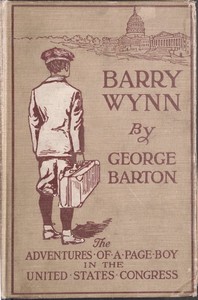
Barry Wynn; Or, The Adventures of a Page Boy in the United States Congress — Text and Context
23
4
Project Gutenberg
2018
Political fiction; Capitol pages -- Fiction; United States. Congress -- Fiction
Readers of public-domain and historical texts
Project Gutenberg digital edition
en
Edition facts
Words: 57,481
Reading time: 250 min
Text sections: 7
Source:
Project Gutenberg record #57137
An editorial note examining George Barton's 1912 novel about a page boy in the U.S. Congress, focusing on authorial choices in diction, dialogue, and description as revealed in excerpts.
Editorial Edition Score
4.7/5
★★★★★
★★★★★
Calculated from edition completeness, EPUB availability, text structure and catalogue metadata. Not a user rating.
Edition quality
George Barton's Barry Wynn; Or, The Adventures of a Page Boy in the United States Congress (1912) opens with a fifteen-year-old protagonist who “grabbed the rail of the day coach” and “swung himself on to the platform … with the ease and enthusiasm of a healthy boy of fifteen.” The verb choices—grabbed, swung—immediately establish physical confidence, while the phrase “the world had suddenly expanded for him” signals a psychological shift. Barton pairs energetic action with interior elevation: Barry’s heart is “swelling with the thought of the big things in the future.” This dual emphasis on bodily movement and emotional inflation recurs throughout the excerpts, forming a consistent authorial pattern.
Diction of Self-Importance and Its Consequences
Barton repeatedly uses language that measures Barry’s internal state against external perception. After an interview with the President, Barry is “filled with a sense of his own importance” and “walked about with his chin very high in the air.” The narrator notes that he “felt like a boy who was walking on clouds,” and a messenger observes that he “didn't know whether he stood on his head or his heels.” These phrases blend colloquial exaggeration with a third-person judgment that distances the reader from Barry’s inflated view. The diction of self-regard—self-gratification, frigid, fate of a nation—culminates in the narrator’s explicit diagnosis: Barry is “passing through that period … when self-importance is apt to overshadow and conceal real worth.” The authorial voice here shifts from showing to telling, but the telling is anchored in the specific vocabulary of adolescent grandiosity.
Dialogue as a Marker of Status and Deception
Barton crafts dialogue that reveals power dynamics and hidden intentions. When Congressman Carlton calls Barry, the exchange is abrupt: “Barry! Barry! … Mr. Carlton wants you right away.” The reply, “I will come in a minute,” is met with “You haven't any time for that.” The imperative tone and the threat of anger (“he'll be very angry if you don't come at once”) show how authority figures control Barry’s movements. Later, the Congressman’s laughter and question—“Why, Barry … what in the world is the matter with you?”—contrast with Barry’s innocent “Nothing.” The dialogue underscores Barry’s obliviousness to the prank played on him. In another scene, the old teacher Smithers calls out, “I am sure you won't fail us—not when you have the assistance of such a bright boy as Barry Wynn.” This praise, reported indirectly, becomes part of the pressure that feeds Barry’s overconfidence. Barton uses direct speech sparingly but strategically to advance the plot and characterize.
Description of Setting and Physical Detail
Barton’s descriptive passages ground the story in the Capitol’s physical spaces. The page boys’ dressing room is “in one of the alcoves in the basement of the Capitol,” furnished with “basins, towels, clothes-closets, and the other furnishings of a room of this character.” On cloudy days, “it was quite dark in this apartment.” This concrete detail sets the stage for the prank: Barry “managed to find his way to the wash-basin” and “opened the spigot.” The description of the prank itself is precise: “another little fellow crept over to the basin and poured something into the water.” The sequence of actions—filling the basin, being distracted, returning, washing—is rendered in simple, chronological prose. Barton also describes Barry’s hurried movement: “he hurried up the marble stairway and along the corridor and into the House.” The repetition of hurried and the specific locations (marble stairway, corridor) create a sense of the Capitol’s labyrinthine layout. These descriptive choices emphasize the contrast between the dignified setting and the boyish mischief.
Recurring Motifs of Vision and Visibility
A subtle but persistent motif in the excerpts is the act of looking and being seen. Barry’s initial “visions of greatness” (chapter title) are literalized when he is “pointed out as the page boy who had been instrumental in saving an important piece of legislation.” The other page boys “received the story in silence,” and Barry “attributed their attitude to envy.” Later, “several persons who passed him on the way, looked at him and laughed, but he paid no attention to them.” The laughter is a visual cue that Barry misreads. The frontispiece caption—“Barry stood for a moment undecided which way to turn”—and the illustration note “His eyes were never removed from the boy's face for a moment” reinforce the theme of scrutiny. Barton uses eyes and glances as shorthand for social judgment. Barry’s failure to see himself as others see him drives the plot: he is blind to the prank, blind to his own arrogance, and blind to the ill will he has generated. The motif of vision thus becomes a structural device for character development.
These excerpts reveal a novelist attentive to the interplay between a boy’s inner life and the public world of the Capitol. Barton’s diction, dialogue, and description work together to dramatize the gap between self-perception and reality. Readers may find it useful to track how often Barry is described as looking, being looked at, or failing to see—and to note how the narrator’s voice shifts from sympathetic to ironic as the story progresses. The evidence suggests a work that uses the page boy’s perspective to explore themes of ambition, humility, and the social mechanics of a powerful institution.
Reader reflection
Take a moment to reflect on this book
Create a short personal record of your experience with this book.
Your progress
0
/
10
2
Was reading this book enjoyable?
3
Would you encourage someone else to read it?
4
How much effort did this book require?
5
Did the book meet your expectations?
6
Did anything about the book feel genuinely new?
7
Do you expect to return to this book?
8
Did it raise ideas you would like to talk about?
9
What did this book teach you most?
10