1

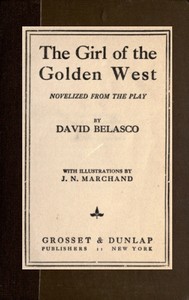
The Girl of the Golden West — Context and Discussion
23
5
Project Gutenberg
2019
Western stories; Women pioneers -- Fiction; California -- Fiction
Readers of public-domain and historical texts
Project Gutenberg digital edition
en
Edition facts
Words: 80,370
Reading time: 350 min
Text sections: 9
Source:
Project Gutenberg record #58800
David Belasco's novelized play follows a mining-camp girl in 1850s California, using sensory-rich prose and shifting narrative pace to contrast her inner life with the violent, masculine world of Cloudy Mountain Camp.
Editorial Edition Score
4.8/5
★★★★★
★★★★★
Calculated from edition completeness, EPUB availability, text structure and catalogue metadata. Not a user rating.
Edition quality
The novel opens with the Girl returning from Monterey, her mind full of the sights and sounds of her first bullfight: the bugle, the roar, the thunder of hoofs. Belasco renders this memory in a single, breathless sentence that piles detail upon detail—the silver-mounted bridles, the beribboned barbs, the red flag—before the paragraph breaks. This is the first of many shifts in narrative pace, from the Girl's dreamy, sensory overload to the clipped, urgent dialogue of the camp's men. The prose itself becomes a kind of frontier, alternating between expansive description and terse, action-driven scenes.
Sensory Overload and the Girl's Interior World
The excerpts reveal a narrator who lingers inside the Girl's perceptions. Her memory of the bullfight is not a summary but a vivid replay: the piercing note of the bugle, the hoarse roar, the thunder of his hoofs. Belasco uses long, cascading lists—rebozos, silken souvenirs, the many-hued capes—to mimic the overwhelm of a first experience. This technique slows the narrative to a near-halt, inviting the reader to inhabit the Girl's heightened awareness. Later, when she climbs the trail home, the prose again expands: the whispering of the mountain's night winds speaks a language as familiar as her own. These passages contrast sharply with the camp's terse exchanges, suggesting that the Girl's interior life is richer and more complex than the world around her.
Abrupt Shifts in Pace and Voice
Belasco frequently cuts from the Girl's lyrical, sensory passages to scenes of rapid, colloquial dialogue. In Chapter IX, Nina Micheltoreña's speech is clipped and bitter: “Ramerrez making love to the Girl?” and “I hate him!” The narrative pace quickens as she reveals the photograph, and the men's reactions are immediate and physical: Ashby snatched it, Rance studied it, then put it away. The storm that bursts outside mirrors the sudden violence of the scene. These shifts are not merely stylistic; they underscore the precariousness of the Girl's world, where moments of quiet reflection can be shattered by a threat. The novel's rhythm—slow, immersive description followed by rapid, tense action—creates a sense of unease, as if the frontier itself might erupt at any moment.
The Landscape as a Character in the Prose
The setting is not just a backdrop but an active force in the narrative's pacing. When the Girl walks home, the prose slows to match her solitary climb: the still black night, the dimly-lighted lantern, the little fortress in the wilderness. Belasco repeats the word alone and describes the trail as something she has watched grow year by year. The mountain's night winds speak a language as familiar as her own, and the horizon is clean, wide, free. These expansive, almost meditative passages contrast with the claustrophobic interiors of the camp's saloons and cabins. The landscape offers the Girl a kind of freedom that the human world denies her, and the prose's pace reflects that: when she is in nature, the sentences lengthen and breathe; when she is among people, they tighten into dialogue and action.
Pay attention to how Belasco uses sentence length and paragraph breaks to signal shifts in mood. The Girl's sensory memories often arrive in long, unbroken lists, while threats and confrontations are delivered in short, punchy lines. This pattern is not accidental; it is the novel's way of mapping the frontier's emotional terrain. Reading with an ear to these changes in pace will reveal the tension between the Girl's inner world and the violent, masculine code of the camp.
Reader reflection
What did you think of this book?
Answer a few questions and save a private reflection on this device.
Your progress
0
/
10
2
Was reading this book enjoyable?
3
Is this a title you would suggest to others?
4
How demanding did the text feel?
5
How did the pace of the book feel?
6
What was the strongest part of the book?
7
How understandable was the text?
8
Would you read this book again?
9
Which lesson or insight stayed with you?
10