1

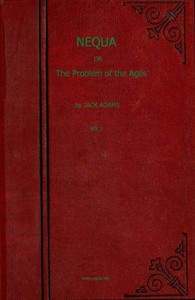
Nequa; or, The Problem of the Ages — A Closer Reading
22
5
Project Gutenberg
2017
Feminism -- Fiction; Utopias -- Fiction; Utopian fiction
Readers of public-domain and historical texts
Project Gutenberg digital edition
en
Edition facts
Words: 118,057
Reading time: 514 min
Text sections: 10
Source:
Project Gutenberg record #55505
A first-person utopian novel following a woman who, after being forced into marriage, disguises herself as a man, joins a polar expedition, and discovers a hidden egalitarian society called Altruria, where she confronts her past and the problem of the ages.
Editorial Edition Score
4.8/5
★★★★★
★★★★★
Calculated from edition completeness, EPUB availability, text structure and catalogue metadata. Not a user rating.
Edition quality
The novel opens with a dedication 'to all lovers of humanity' and a table of contents that promises a polar adventure: a ship trapped in ice, a mysterious tower, and an airship fleet. The first-person narrator, writing under the pseudonym Jack Adams, begins her story beneath the midnight sun, where a strange visitor descends from above. The early chapters establish a brisk, episodic structure, moving from a perilous Arctic voyage to the discovery of a hidden civilization called Altruria.
The excerpts reveal a narrative voice that is both confessional and argumentative, as the protagonist recounts her past: forced into marriage with an elderly uncle, she fled, disguised herself as a man, and spent fifteen years searching for her betrothed, Raphael Ganoe. This backstory is delivered in a single, unbroken monologue to a sympathetic listener, Oqua, setting up the novel's central tension between personal trauma and the utopian ideals of Altruria.
A Polar Expedition as a Frame for Social Critique
The opening chapters use a classic adventure setup—a ship called the Ice King heading to the North Pole—to introduce themes of disguise and discovery. The narrator, in male attire, enlists as a scientist, and the crew faces an earthquake, a closing channel, and imprisonment in ice. These events are described with concrete detail: 'the channel is closing,' 'the ship is lost.' The structure shifts abruptly when the ship is rescued by an airship fleet, revealing Altruria, a society where 'drudgery and poverty both abolished.' This pivot from survival narrative to utopian exposition is the novel's defining formal move.
The catalog subjects list 'Feminism -- Fiction' and 'Utopias -- Fiction,' and the excerpts bear this out: the polar journey serves as a literal and figurative passage from a world of legal wrongs to one of natural rights. The narrator's disguise is not merely a plot device but a lens through which she observes gender roles and social hypocrisy.
The Confession Scene and Its Ethical Knot
The longest excerpt presents a dialogue between the narrator and Oqua, an Altrurian woman, after the narrator has revealed her past. The narrator expects sympathy for her suffering, but Oqua responds with a logical puzzle: if the narrator was betrothed to Raphael, her later marriage to another man was a violation, regardless of coercion. Oqua says, 'you have not committed any wrong, and I do not understand what it is that you are feeling so badly about.' This moment crystallizes the novel's central debate about moral responsibility versus social conditioning.
The narrator's anguish is rooted in her society's norms, while Oqua applies a different ethical framework. The scene is structured as a back-and-forth clarification, with the narrator insisting on her victimhood and Oqua redefining the terms. This dialogue is the emotional and intellectual core of the excerpts, showing the novel's interest in questioning received ideas of guilt and innocence.
Altruria as a Mirror and a Challenge
When the narrator arrives in Altruria, she encounters a world that is 'strikingly similar to America' yet fundamentally different. The excerpts describe a 'colossal communal Home' under the Pacific Ocean, a phonographic enunciator for language learning, and citizens who are 'numbered, labeled and registered.' The narrator is given a new name—Nequa—and must shed her old identity. This renaming ritual underscores the novel's theme of rebirth through social transformation.
The utopian details are presented as matter-of-fact improvements: 'freedom the rule,' 'the first revolt against landlordism.' But the excerpts also hint at tension. The narrator's disguise is 'penetrated,' and she must confront her past. Altruria is not a simple paradise but a place where her old assumptions are tested. The novel uses this setting to explore whether personal healing is possible within a perfect society.
Narrative Structure and the Problem of the Ages
The novel's full title, Nequa; or, The Problem of the Ages, frames the story as an inquiry into a persistent social issue. Based on the excerpts, that problem appears to be the conflict between legal institutions and natural justice, particularly regarding marriage and gender. The narrator's journey from the Arctic to Altruria mirrors her movement from a world of 'legal wrongs' to one where 'human rights' are practiced.
The structure is episodic: a shipwreck, an air voyage, a confession, a new identity. Each episode introduces a new facet of the problem. The excerpts do not reveal the resolution, but they establish a pattern of contrast and critique. The narrator's voice remains central, blending personal testimony with social commentary. Readers should attend to how the novel balances its adventure plot with its philosophical dialogues, and how the utopian setting serves not as an escape but as a crucible for the narrator's unresolved past.
As you read Nequa, pay attention to the way the narrator's first-person account shifts between action and reflection. The polar expedition and the utopian society are not separate genres but intertwined modes of inquiry. The confession scene with Oqua is a key to the novel's method: it stages a debate about moral responsibility that the rest of the book may complicate or resolve. The excerpts suggest that the 'problem of the ages' is not solved by Altruria's existence but by the narrator's struggle to reconcile her past with its ideals.
Reader reflection
What was your reading experience?
Capture what you thought, learned, and would like to remember.
Your progress
0
/
10
2
Was reading this book enjoyable?
3
Would you pass this book on to a friend?
4
How demanding did the text feel?
5
Would this book work well in a reading group?
6
Could you follow the author’s main argument?
7
Did any part of the book stay with you emotionally?
8
How original did the book feel?
9
Which lesson or insight stayed with you?
10