1

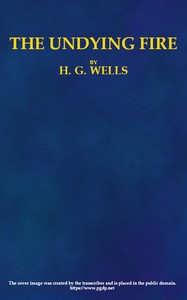
The Undying Fire: A contemporary novel — Reading Companion
32
6
Project Gutenberg
2020
English fiction -- 20th century; Job -- (Biblical figure) -- Fiction; Bible. Job -- Adaptations
Readers of public-domain and historical texts
Project Gutenberg digital edition
en
Edition facts
Words: 50,375
Reading time: 220 min
Text sections: 12
Source:
Project Gutenberg record #61547
Wells recasts the Book of Job as a modern debate on immortality, suffering, and cosmic purpose, framed by a prologue in heaven and a schoolmaster's crisis. The novel pits a skeptical protagonist against three visitors who offer conventional consolations, while the narrative voice undercuts celestial grandeur with ironic, scientific imagery.
The novel opens with a deliberately jarring celestial scene: two eternal beings converse amid surroundings that blend pre-Raphaelite opulence with a futurist's cosmic speculation. Wells describes pillars vanishing into darkness and decorations traced by elemental particles, while suns and planets spin through a floor of crystalline ether. This prologue immediately establishes the book's central tension—ancient religious narrative refracted through modern scientific and philosophical skepticism.
The story then shifts to Sundering-on-Sea, where schoolmaster Mr. Huss faces a crisis of faith and health. His three visitors—Sir Eliphaz, Dr. Elihu Barrack, and others—arrive to debate the nature of immortality, echoing the biblical Job's comforters. The excerpts reveal a work that is less a straightforward novel than a sustained argument about suffering, justice, and the possibility of meaning in a seemingly indifferent universe.
The Prologue as Parody and Framework
The opening chapter, titled “The Prologue in Heaven,” signals Wells’s intention to rewrite the Book of Job for a modern audience. The description of the setting—a fusion of traditional heavenly palace and “cosmic tendency”—is described as if a futurist painter had repainted pre-Raphaelite designs with a knowledge of modern chemistry and physics. This self-conscious, almost mocking tone undercuts any solemnity. The two eternal beings are “magnificently enhaloed,” one in white radiance, the other in a bewildering extravagance of colors, yet their surroundings have no definite locality and are “above and comprehensive of the material universe.” Wells uses this cosmic stage to frame the human drama that follows, but the irony suggests that heaven itself is a human construct, subject to the same intellectual fashions as earthly art.
Debating Immortality: The Visitors' Arguments
In the chapters set at Sea View, the three visitors—Sir Eliphaz, Mr. Farr, and Mr. Dad—present their views on life after death. Sir Eliphaz, with his “florid defiance,” hedges his beliefs in spiritualist jargon, claiming that earthly expressions can only “body forth spiritual things.” Mr. Dad offers weak support, while Dr. Elihu Barrack responds with disgust, challenging the logic of spiritualism: “If I was born with a hare lip, would that be put right? What becomes of a dog one has shot for hydrophobia?” Mr. Huss, the Job figure, rejects these consolations outright. He insists that immortality cannot be a “dodging away” from the world’s pain. His critique is grounded in the physical reality of suffering: the crushed frog, the trampled anthill, the penguin roasted alive for oil. For Huss, any credible answer must account for all suffering, not just human grief.
The Texture of Reality: Suffering as a Test of Truth
Mr. Huss’s central argument against spiritualism is that it lacks “the feel of reality.” He measures truth by tangible experience: pain, desire, muscular effort, the sensation of sunshine or rain. The spiritualist vision, he says, is “contrary to the texture of everything we know” and “less convincing than the wildest dreams.” His own grief is embodied in the memory of his son’s “broken and crumpled” body, and he refuses to let a “half fool and half impostor” sit upon that body with cheap talk of astral planes. Wells gives Huss a voice that is both intellectual and visceral, sweating and gripping the table as he speaks. The novel thus sets up a stark opposition: between abstract, comforting doctrines and the unadorned, painful facts of existence. The question of whether a coherent God exists—or can remain silent—hangs over every exchange.
Readers approaching The Undying Fire should be prepared for a novel that is more philosophical dialogue than narrative. The biblical framework provides structure, but Wells’s interest lies in the clash of ideas. Pay attention to how the prologue’s cosmic irony colors the debates that follow, and note that Huss’s arguments often carry the emotional weight, while his visitors’ positions are rendered with satirical edge. The book rewards those who engage with its central question: can suffering be justified without recourse to easy answers?
Reader reflection
What did you think of this book?
Answer a few questions and save a private reflection on this device.
Your progress
0
/
10
2
Did this book hold your interest?
3
How likely are you to recommend this book?
4
What was the reading difficulty like?
5
Did anything about the book feel genuinely new?
6
Was the book what you thought it would be?
7
Did it raise ideas you would like to talk about?
8
How useful were the ideas in this book?
9
What did this book teach you most?
10