1

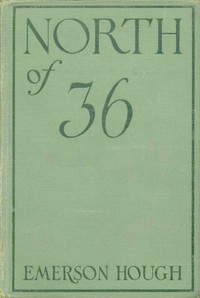
North of 36 — Text and Context
21
3
Project Gutenberg
2019
Western stories; Texas -- Fiction; Cattle drives -- Fiction
Readers of public-domain and historical texts
Project Gutenberg digital edition
en
Edition facts
Words: 118,968
Reading time: 518 min
Text sections: 14
Source:
Project Gutenberg record #59201
Emerson Hough's 1923 novel follows Taisie Lockhart, a young ranch heiress, and her foreman Jim Nabours as they drive a herd of longhorns from Texas to Abilene, Kansas. The excerpts reveal a tense romance, detailed cattle-drive logistics, and encounters with Comanche territory, though the catalog subject 'Utopias' is not supported by the text.
Editorial Edition Score
4.9/5
★★★★★
★★★★★
Calculated from edition completeness, EPUB availability, text structure and catalogue metadata. Not a user rating.
Edition quality
Emerson Hough's North of 36 opens with a scene that immediately establishes social hierarchy on a Texas ranch: Taisie Lockhart, described as the 'hereditary chieftainess,' approaches the cook house, and the men's reaction—pushing back chairs and staring at the boss 'as though caught in some overt criminal act'—underscores the formality of cattle-hand etiquette. The narrative voice is direct, with dialogue that mixes romantic tension and practical concerns, as when Jim Nabours declares, 'My honor is as good as you are good.' The excerpts show a story grounded in the specifics of a cattle drive, from the 'deep paths of the buffalo' to the absence of maps, rather than the utopian themes suggested by the catalog category.
Catalog vs. Content: The Missing Utopia
Project Gutenberg categorizes North of 36 under 'Utopias, Future Societies & Other Worlds,' yet the excerpts contain no trace of utopian speculation. The novel is firmly set in the historical American West, circa the 1870s, focusing on the practicalities of moving a cattle herd north. Characters discuss the 'Indian Department' policy of rounding up tribes onto reservations, the absence of white settlement, and the lack of maps—details that reflect frontier reality, not an idealized society. The only hint of an alternative world is the description of the 'wild paradise' of the Indian Nations, but this is presented as unsettled, not utopian. Readers expecting a visionary future will find instead a gritty, period-specific narrative.
Voice and Structure: The Melodramatic Romance
The excerpts reveal a strong melodramatic strain in the dialogue, particularly in the love scenes. Taisie and McMasters speak in heightened, almost theatrical language: 'Unclean! Unclean! Look at my hands—they’re red, I say.' The repetition of 'I suppose' and the characters' inability to change—'That’s my curse—I can’t change'—suggest a deterministic view of character. The narrative also shifts between intimate moments and broad landscape description, as when the herd passes through country where 'there never had been hoof of any domestic creature.' This juxtaposition of personal drama and epic setting is a hallmark of Hough's style, but the excerpts do not indicate how these elements are balanced across the full novel.
Setting and Detail: The Unmapped Trail
Hough pays close attention to the geography and logistics of the cattle drive. The herd follows 'the ridges that separated the heads of divergent streams,' and the characters explicitly note they are not on the Chisholm Trail. The absence of maps is a recurring motif: 'I don’t know where we are right now. I don’t know where we’re going. We haven’t got no map.' This uncertainty contrasts with the romantic plot, grounding the story in the physical challenges of the journey. The excerpts also mention specific tribes (Comanches, Kiowas) and historical figures (Captain Marcy), lending authenticity. However, the full extent of the drive—from Texas to Abilene—is only hinted at through chapter titles like 'Till Abilene' and 'Abilene.'
Readers should approach North of 36 as a product of its time—a 1923 novel that blends Western adventure with a romantic subplot, written by an author known for popularizing the genre. The catalog's 'Utopias' label is misleading; the text is firmly historical. Pay attention to how Hough uses dialogue to convey character and conflict, and note the tension between the epic scale of the cattle drive and the intimate, often overwrought, love story. The excerpts suggest a work that values atmosphere and period detail over plot innovation.
Reader reflection
Your personal reading reflection
Build a private reading journal entry for this title.
Your progress
0
/
10
2
What was your overall reaction to the book?
3
Would you encourage someone else to read it?
4
How much effort did this book require?
5
Which part made the strongest impression?
6
How strongly did the book affect you emotionally?
7
Would a second reading be valuable?
8
Did the book deliver what you hoped for?
9
In one sentence, what did you learn?
10