1

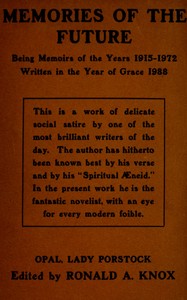
Memories of the future — Edition Insights
32
5
Project Gutenberg
2019
Satire, English; English fiction -- 20th century; Twentieth century -- Forecasts
Readers of public-domain and historical texts
Project Gutenberg digital edition
en
Edition facts
Words: 72,038
Reading time: 314 min
Text sections: 21
Source:
Project Gutenberg record #59388
A satirical memoir from 1988 looking back at 1915–1972, with a fictional editor's preface and an author's preface that playfully argue about the future. The wedding chapter shows how Knox mocks modernized marriage ceremonies through invented prayer books and opalescent suits.
Editorial Edition Score
4.8/5
★★★★★
★★★★★
Calculated from edition completeness, EPUB availability, text structure and catalogue metadata. Not a user rating.
Edition quality
The book opens with two prefaces that immediately establish its satirical method: an Editor's Preface that calls itself 'a fugal variation on the Author's Preface, which follows.' The editor argues that 'we do ill, if we fail in veneration for the future,' while the author's own preface presumably takes a different stance. This layered framing—a memoir written in 1988 about 1915–1972, itself edited by Knox—creates a hall-of-mirrors effect where the reader must constantly ask who is being mocked.
The excerpts show Knox's precise ear for bureaucratic and liturgical language. In the wedding chapter, the narrator reports that a 'Book of Modern Prayer' was rejected because the vows included clauses about 'permanent insanity, cruelty, infidelity, or incompatibility of temperament.' The satire works through accumulation of specific, plausible-sounding absurdities rather than broad caricature.
The Double Preface as a Reading Compass
The Editor's Preface warns against 'sneering at what is new-fangled' while simultaneously doing exactly that through its elaborate prose. The author, writing as 'Opal, Lady Porstock,' claims to be a memoirist of the future, but Knox's own voice keeps breaking through. Readers should pay attention to which statements seem sincere and which are ironic—the line is deliberately blurred.
The preface mentions 'the H. G. Wells-tedium that manhood endured,' a clue that Knox is writing against the utopian tradition. The Herodotus epigraph—'Anything can happen in the long course of time'—signals that the book will play with historical inevitability. The table of contents shows a conventional memoir structure (Childhood, School Days, Oxford) that will be subverted by later chapters like 'An Old Way of Making a New Departure.'
The Wedding as a Microcosm of Satirical Method
The wedding chapter (from 'My Marriage') demonstrates Knox's technique of extrapolating contemporary trends to absurd conclusions. The bride's mother insists on 'giving me away,' described as 'a pretty old custom which was even then falling into use'—the inversion of 'falling into disuse' signals the narrator's skewed perspective. The groom's opalescent suit, 'specially made for him in Paris,' is presented as a compliment to the bride but described as 'a silly compliment.'
The debate over wedding vows is the set piece. Three versions are considered: Mrs. Rowlands' 'Book of Modern Prayer,' which asks the bride to 'love, humour, and tolerate him, in sickness (other than permanent insanity) and in health'; 'The Revised Book of Common Prayer,' which alters 'obey and serve' to 'respect and co-operate with him'; and the traditional service. The final choice includes the proviso 'until the King shall take other order,' which the groom interprets as requiring the King to 'set his alarum clock at three any morning.'
Voice and Unreliable Narration
The narrator, Opal, Lady Porstock, writes with a tone of genteel bemusement that masks sharp observation. She reports that her friend Juliet whispered during the ceremony that her nervousness was 'a relic of marriage by capture'—a phrase that recurs from earlier in the chapter. This repetition suggests the narrator is aware of anthropological theories but treats them as conversational currency rather than serious analysis.
Knox uses the memoir form to satirize both the past and the future simultaneously. When Opal notes that 'cheques were already the usual form' for wedding presents, and that 'the stupid and invidious habit of itemizing the list of cheques had not then grown up,' she is criticizing her own era's practices while pretending to describe them neutrally. The reader must constantly adjust for the narrator's blind spots.
Structure and the Reader's Expectations
The table of contents promises a conventional life story, but the chapter titles hint at satire: 'London Society and its Follies,' 'Great Men of the Day,' 'England on the Eve of the Great War.' The final chapter, set in 1972, describes 'the Great War'—presumably a future conflict unknown to the reader. This temporal dislocation is central to the book's effect.
Readers should note that the excerpts provide only the Editor's Preface and the wedding chapter. The memoir's overall arc—from childhood in 1915 to the eve of war in 1972—is not fully represented. The satirical targets likely include progressive education, American culture (Chapter VII), parliamentary politics, and technological change. The wedding chapter's focus on ritual and language suggests that Knox is particularly interested in how institutions adapt (or fail to adapt) to changing mores.
Approach Memories of the Future as a puzzle in which the narrator's voice is the primary source of comedy. Opal, Lady Porstock, is both a character and a mouthpiece; her earnest descriptions of absurd customs require the reader to supply the irony. The book rewards attention to small details—the exact wording of a prayer book, the fabric of a suit, the phrasing of a compliment. Knox's satire is cumulative rather than punchy, and the memoir form allows him to sustain a single, consistent tone of polite bewilderment throughout.
Reader reflection
How will you remember this book?
Save your reaction, strongest insight, and memorable passage.
Your progress
0
/
10
2
How did the book work for you overall?
3
Would you recommend this book to another reader?
4
Did the language feel accessible?
5
How clear did the writing feel?
6
Would you start a conversation about this book?
7
How did the reading compare with what you expected?
8
Is this a title worth rereading?
9
What changed or sharpened your thinking?
10