1

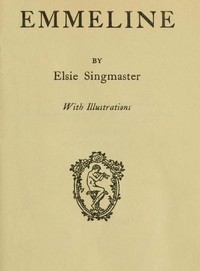
Emmeline — Context and Discussion
22
3
Project Gutenberg
2017
War stories; Gettysburg, Battle of, Gettysburg, Pa., 1863 -- Fiction; Pennsylvania -- History -- Civil War, 1861-1865 -- Fiction
Readers of public-domain and historical texts
Project Gutenberg digital edition
en
Edition facts
Words: 21,395
Reading time: 94 min
Text sections: 10
Source:
Project Gutenberg record #55627
Elsie Singmaster's 1915 novel follows fifteen-year-old Emmeline Willing during the Battle of Gettysburg. The excerpts show her initial shame at her Southern sister-in-law, her flight from home, and her reluctant nursing of wounded soldiers. The catalog subjects emphasize war and battle, but the text focuses on Emmeline's domestic labor and emotional growth.
Editorial Edition Score
4.7/5
★★★★★
★★★★★
Calculated from edition completeness, EPUB availability, text structure and catalogue metadata. Not a user rating.
Edition quality
Elsie Singmaster's Emmeline (1915) opens not with cannon fire but with a fifteen-year-old girl curled up on the rear seat of an old surrey in a wagon shed. The catalog subjects—War stories, Gettysburg, Battle of—suggest a military focus, yet the excerpts devote far more attention to Emmeline's domestic routine: feeding chickens, washing dishes, picking raspberries, and raveling lint. The battle arrives obliquely, filtered through her chores and her shame over Sister Bertha, a Southern-born rebel. Singmaster builds the war's pressure through small, concrete details rather than grand set pieces.
The War at Home: Chores and Shame
The excerpts show Emmeline's world as a round of household tasks. She rises at six, feeds chickens, washes dishes, picks raspberries, and ravels lint—the last a wartime chore, preparing bandages. Her deepest conflict is not with the enemy but with her sister-in-law Bertha, a Southerner married to her brother Henry. Emmeline is “deeply ashamed” of Bertha, whom she calls a rebel. The catalog labels the book a war story, but the early tension is domestic and familial. Singmaster uses Bertha to embody the Civil War's division within a single household, a theme that emerges through Emmeline's private feelings rather than battle scenes.
Flight and the Sound of Battle
When the fighting reaches Gettysburg, Emmeline does not join a regiment; she runs. The excerpts show her fleeing home, then watching from a hillside as the cannon roar. She longs to return but realizes she cannot. The battle is rendered through her senses—the “roar of cannon,” the sight of horses and wagons—not through tactical description. Singmaster keeps the focus on Emmeline's physical and emotional state: she rises “stiffly,” her longing for home grows “keener.” The war is a backdrop that forces her into motion, but the narrative stays anchored in her limited perspective.
Nursing the Enemy: A Reluctant Education
Emmeline's most dramatic transformation occurs when she is pressed into nursing wounded soldiers. Private Christy, an enemy soldier, commands her to bring warm water and cloths. She is paralyzed at first, then weeps, then obeys. Singmaster emphasizes her reluctance: “Emmeline wished that the earth would open and swallow her.” The work is messy and unglamorous—binding wounds, filling a boiler, keeping the kitchen clear. Private Christy protects her room above the kitchen, insisting it stay empty. The excerpts show Emmeline taking “another great step toward womanhood” through this labor, not through heroism. The war is a catalyst for domestic service, not adventure.
Readers expecting a battle chronicle will find instead a story of a girl learning to nurse under duress. Singmaster's prose stays close to Emmeline's senses—the heat, the stiffness, the sound of bugles—and avoids sweeping judgments. The excerpts suggest a novel more concerned with the texture of wartime domesticity than with military strategy. Pay attention to the small tasks: raveling lint, filling a basin, keeping a room clear. They carry the weight of the story.
Reader reflection
Before you leave, reflect on the book
Use these questions to collect your thoughts before moving on.
Your progress
0
/
10
2
What was your overall reaction to the book?
3
Would you encourage someone else to read it?
4
What was the reading difficulty like?
5
Which part made the strongest impression?
6
Do you expect to return to this book?
7
How useful were the ideas in this book?
8
How did the pace of the book feel?
9
What did this book teach you most?
10