1

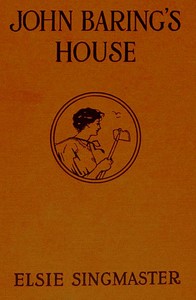
John Baring's House — Inside the Classic
20
4
Project Gutenberg
2018
Kidnapping -- Juvenile fiction; Siblings -- Juvenile fiction; Gettysburg Campaign, 1863 -- Juvenile fiction
Readers of public-domain and historical texts
Project Gutenberg digital edition
en
Edition facts
Words: 28,426
Reading time: 124 min
Text sections: 11
Source:
Project Gutenberg record #56416
In this 1920 novel set near Gettysburg, Elizabeth Scott and her brother Herbert face a kidnapping threat after moving into an isolated old house. The story balances domestic labor with mounting dread, using the house's physical presence and the siblings' contrasting temperaments to build tension.
Editorial Edition Score
4.7/5
★★★★★
★★★★★
Calculated from edition completeness, EPUB availability, text structure and catalogue metadata. Not a user rating.
Edition quality
The first chapter of John Baring's House opens with Elizabeth Scott leaning against the stone wall of the old house after a day of preparing meals and hoeing the garden. The June twilight and the hard work establish a domestic rhythm that is immediately undercut by a note of dependency in her brother Herbert's voice. Singmaster uses the house itself as a silent character: it “seemed gradually to sink into the woodland,” and later, when Elizabeth returns alone, she feels “afraid of the great bulk, afraid of the dark corners.” The setting is not merely backdrop but an active source of unease.
Sibling Dynamics Under Pressure
Elizabeth and Herbert are defined by contrast. Elizabeth is described as having “briskness and firmness” — qualities that opponents call stubbornness — while Herbert’s voice has a “dependent quality” and his motions still show the effects of a long illness. This asymmetry is central to the tension: Elizabeth assumes responsibility for both the household and her brother’s safety, yet her competence is repeatedly tested by the threats that emerge.
When Herbert fails to return from a ride, Elizabeth’s internal monologue reveals a rapid shift from practical worry to terror. She tries to calm herself with her mother’s proverb about an empty stomach, but the thought she cannot suppress is that “in a few minutes it will be quite dark.” Her fear is not abstract; it attaches to the house’s “deep cellar and the cubby-holes in the attic.” The sibling bond is the emotional core, but it also makes Elizabeth vulnerable to manipulation.
Threats Delivered Through Objects
Singmaster conveys danger not through direct confrontation but through objects left in the house. The first notice — a scrap of paper with a “gruesome sign of skull and cross-bones” — is followed by a second, tossed through a window, demanding “You bring that paper and you can hav him back.” The misspelling and crude drawing make the threat feel both immediate and anonymous.
Elizabeth’s reaction is telling: she does not know what “paper” is meant. She wonders if it is the will she wrote for a poor old woman, but the uncertainty only deepens her panic. The objects — the notices, the missing horse Joe, the empty stable — become triggers for a fear that spreads from the house into the surrounding woods. The narrative withholds the identity of the kidnappers, keeping the reader inside Elizabeth’s limited knowledge.
The Landscape as a Labyrinth
When Elizabeth sets out into the woods after Herbert, the landscape resists her. She walks into trees, and “long shoots of crow’s-foot, which grew only in the deeper woods, reached out and grasped her ankles.” The road itself becomes uncertain; she realizes she must turn back before she loses it entirely. The echo of her own calls — “Herbert! Herbert!” — returns from the higher hill, but she cannot tell if it is a mocking voice.
This scene transforms the familiar woodland into a labyrinth. The house, which had seemed a refuge, is now a point to flee from and return to. Singmaster uses the physical environment to externalize Elizabeth’s psychological state: the darkness, the grasping plants, the unreliable echoes all mirror her growing helplessness. The setting is not picturesque but actively hostile, a space where the known becomes strange.
Readers should pay attention to how Singmaster uses the house and its surroundings as more than setting — they are extensions of the characters’ emotions and the story’s central conflict. The incomplete excerpts leave many questions unanswered: the identity of the kidnappers, the nature of the “paper,” and whether Elizabeth’s resourcefulness will be enough. The novel rewards attention to small details, such as the contrast between Elizabeth’s briskness and her moments of paralysis, and the way objects (a lamp, a scrap of paper, a stable) accumulate meaning as the plot unfolds.
Reader reflection
How will you remember this book?
Save your reaction, strongest insight, and memorable passage.
Your progress
0
/
10
2
What was your overall reaction to the book?
3
Would you encourage someone else to read it?
4
Did the language feel accessible?
5
Did it raise ideas you would like to talk about?
6
Could you follow the author’s main argument?
7
Did the story or argument move comfortably?
8
Did the book deliver what you hoped for?
9
In one sentence, what did you learn?
10