1

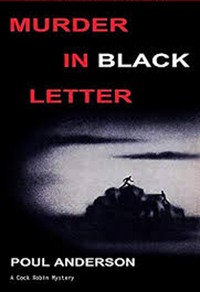
Murder in Black Letter — Reading Companion
22
3
Project Gutenberg
2019
Detective and mystery stories; Murder -- Investigation -- Fiction; Berkeley (Calif.) -- Fiction
Readers of public-domain and historical texts
Project Gutenberg digital edition
en
Edition facts
Words: 59,422
Reading time: 259 min
Text sections: 6
Source:
Project Gutenberg record #59369
Poul Anderson's 1960 mystery follows historian Robert Kintyre and detective Trygve Yamamura in Berkeley, where a murder investigation intertwines with Renaissance fencing, academic life, and a Siamese cat named Taffimai Metallumai. The opening excerpts establish a distinctive voice blending scholarly detail with hardboiled dialogue.
Editorial Edition Score
4.7/5
★★★★★
★★★★★
Calculated from edition completeness, EPUB availability, text structure and catalogue metadata. Not a user rating.
Edition quality
The first chapter of Murder in Black Letter opens not with a body but with a saber duel between two men in a Berkeley garden. Robert Kintyre, a historian, fences with Trygve Yamamura, a detective of Japanese descent, and their banter immediately establishes a partnership grounded in mutual respect and contrasting expertise. The setting—a rented cottage behind a vacant house, enclosed by board fences and climbing blossoms—is domestic yet charged with the potential for violence. Anderson’s prose is lean and specific: Kintyre’s gait marks him as a judo man, Yamamura’s face is “long, high-cheeked,” and the sky is “tall.” These details root the story in a particular time and place while hinting at the intellectual and physical rigor to come.
A Historian’s Eye for Detail
Kintyre is introduced not only as a fencer but as a scholar who prefers the saber because it is “a wee bit closer to the Renaissance weapon.” This offhand remark signals his professional lens: he sees the world through historical analogies and material culture. When he later visits Corinna’s apartment, he notes her bookshelves hold poetry, drama, art, and popular science—Gamow, Russell, Ley—and her cat is named from Kipling. These observations are not mere decoration; they build a character who reads people through their possessions and habits. Anderson trusts the reader to infer Kintyre’s method from such details rather than from explicit deduction.
The Hardboiled Register and Its Limits
The dialogue in the excerpts often veers toward the hardboiled: “Start acting like it,” “Your castoff mistress,” “Get the devil out of this hole!” Yet Anderson undercuts this register with moments of genuine awkwardness. When Kintyre apologizes—“I’m not sure what I did wrong just now, but I’m sorry”—the confession is both human and disarming. The exchange with Margery reveals a man who can be blunt and self-righteous but also capable of self-doubt. This tonal range prevents the characters from becoming mere types. The hardboiled style is a performance that Kintyre sometimes fails to sustain, and those failures are where the novel’s emotional complexity emerges.
Berkeley as a Character
The catalog subjects list Berkeley, California, as a setting, and the excerpts confirm its importance. The garden, the dojo, the apartment near Golden Gate Park, the news rack with an extra edition—these are not generic backdrops but specific locations that shape the story’s rhythm. Anderson mentions the University of California and the Berkeley Police Department in his disclaimer, noting that he does not imply either institution condones the actions of his characters. This careful boundary-drawing suggests the novel engages with real institutions while remaining a work of fiction. The academic milieu is not merely decorative; it provides a plausible context for Kintyre’s historical expertise and for the kind of intellectual puzzle the murder may become.
The Cat Who Is Not a Clue
Corinna’s Siamese cat, Taffimai Metallumai—called Tipsy—is introduced with a Kipling reference and a warning that she bites. The cat is pure muscle under her fur, and she levitates onto Kintyre’s lap demanding attention. In a lesser mystery, such a pet might be a red herring or a source of vital information. Here, the cat seems to exist simply as a detail of Corinna’s life, a marker of her independence and her taste for the whimsical. Anderson does not overplay the cat’s role; she is present without being portentous. This restraint is typical of the excerpts, which accumulate texture without forcing every element into the plot machinery. Readers should enjoy the cat for what she is: a small, vivid presence in a world already crowded with human complication.
The excerpts from Murder in Black Letter offer a first reading that is less about following a chain of clues than about inhabiting a particular world. Anderson’s prose rewards attention to physical detail—the weight of a saber, the feel of a cat’s muscle, the angle of a headline. The mystery itself remains largely offstage in these pages, but the groundwork is laid in character and setting. Readers who approach the novel as a period piece, attentive to its 1960 Berkeley atmosphere and its blend of scholarly and hardboiled registers, will find a story that earns its twists through patient observation.
Reader reflection
What did you think of this book?
Answer a few questions and save a private reflection on this device.
Your progress
0
/
10
2
How much did you enjoy the reading experience?
3
Would you encourage someone else to read it?
4
How much effort did this book require?
5
What was the strongest part of the book?
6
Did you relate to its people, ideas, or situations?
7
Did the story or argument move comfortably?
8
Could you apply anything you learned?
9
What is the main idea you are taking away?
10