1

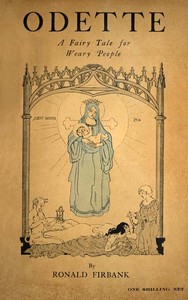
Odette: A Fairy Tale for Weary People — Themes and Context
29
7
Project Gutenberg
2019
Conduct of life -- Fiction; Girls -- Fiction; France -- Fiction; Catholics -- Fiction
Readers of public-domain and historical texts
Project Gutenberg digital edition
en
Edition facts
Words: 6,705
Reading time: 30 min
Text sections: 5
Source:
Project Gutenberg record #58720
In Ronald Firbank's 1916 fairy tale, young Odette d'Antrevernes moves between a chateau on the Loire and a moonlit encounter with a destitute woman, blending ornate description with Catholic piety and a sudden turn toward social awareness.
Editorial Edition Score
4.5/5
★★★★★
★★★★★
Calculated from edition completeness, EPUB availability, text structure and catalogue metadata. Not a user rating.
Edition quality
Ronald Firbank's Odette: A Fairy Tale for Weary People (1916) opens with a long, languid sentence that establishes a world of evening shadows, a cathedral turning purple in the sunset, and a child stealing out to hear birds murmur 'good-night.' The prose is deliberately decorative—'the Loire, all amongst the flowery meadows and emerald vineyards, like a wonderful looking-glass'—and the setting is a chateau in France, complete with an aunt embroidering an altar cloth and a Creole nurse named Fortune. The catalog subjects list 'Conduct of life,' 'Girls,' 'France,' and 'Catholics,' and the excerpts bear out the Catholic element prominently: Odette prays to the Holy Virgin, wears a cross given by her mother, and converses with the village curé. Yet the tale's fairy-tale trappings are undercut by a nocturnal encounter with a poor woman that introduces hunger, homelessness, and the possibility of failure.
A Fairy Tale with a Turn toward the Street
The excerpts show that Odette begins firmly in fairy-tale territory: a chateau, a river like a looking-glass, a nearby castle 'like an ogre’s castle,' and a child who tells herself stories. But the narrative shifts abruptly when Odette, having slipped out at night to pray, meets a woman who is tired, hungry, and without work. The woman asks whether Odette's cross is 'really silver' and says she will keep it 'in memory of you, little one' and that 'It may bring me luck.' Odette responds by asking the woman to promise 'never to do things that the Holy Mary would not approve of.' The exchange is polite but stark: the child offers piety, the woman accepts a valuable object, and the story does not resolve the woman's plight. The fairy-tale setting—the chateau, the limes, the thrushes—remains intact, but the encounter introduces a note of economic desperation that the catalog subject 'Conduct of life' only partly captures.
Catholic Piety as a Structural Device
The catalog lists 'Catholics' as a subject, and the excerpts confirm that Catholic imagery and prayer are woven into the narrative. Odette's mother gave her a cross and told her 'to love the Holy Virgin, for that faith, and love, were the only things that were beautiful in life.' Her aunt embroiders an altar cloth. Odette prays to 'Holy Virgin, Mother of Our Lord Seigneur Christ' after the woman leaves. The curé visits, and Odette wonders 'if Monsieur le Curé had really seen God.' Yet the piety is not merely decorative: it drives the plot. Odette's decision to go out at night to pray leads directly to the encounter with the woman. Her prayer after the woman departs is specific and practical—'Take into Thy protection, dear Mother, this poor woman who has need of Thee'—and it is followed by a moment of realization: 'Life was not a dream; she realized for the first time that Life was cruel, that Life was sad.' The fairy-tale frame is thus used to stage a moral awakening that is explicitly Catholic in its vocabulary.
The Limits of the Excerpts: What We Cannot Know
The excerpts provided cover only the opening pages and a later nocturnal scene. They do not reveal the full arc of Odette's story, nor do they show how the fairy-tale elements—the chateau, the ogre's castle, the birds saying prayers—resolve. The catalog subject 'Girls' is present, but the excerpts offer only one girl, Odette, and no indication of other female characters beyond the aunt and the poor woman. 'France' is clearly the setting, but the story may or may not engage with French history or culture beyond the chateau and the Loire. The subject 'Conduct of life' is illustrated by Odette's moral awakening, but the excerpts do not show whether she acts on that realization. Readers should approach the text as a brief work (about 6,700 words) that uses fairy-tale conventions to stage a single, pivotal encounter, but the complete narrative may develop or complicate the themes introduced in these passages.
Firbank's Odette is a short work that rewards attention to its prose rhythms and its careful juxtaposition of the ornate and the plain. The fairy-tale language—'the bent cyclamens by the river-side lifted their fragrant hearts in rapture'—sits beside blunt statements about hunger and work. Readers may find it useful to track how the narrator's voice shifts between these registers, and to consider whether the ending confirms or complicates Odette's dawning awareness of suffering. The illustrations by Albert Buhrer, mentioned on the title page, are not included in this digital edition, but their presence in the original 1916 volume suggests a visual dimension that might further shape the story's tone.
Reader reflection
What did you think of this book?
Answer a few questions and save a private reflection on this device.
Your progress
0
/
10
2
Was reading this book enjoyable?
3
Would you recommend this book to another reader?
4
How much effort did this book require?
5
Would a second reading be valuable?
6
Did anything about the book feel genuinely new?
7
How well did it match your expectations?
8
How clear did the writing feel?
9
What is the main idea you are taking away?
10