1

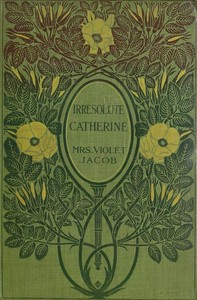
Irresolute Catherine — Key Ideas to Explore
21
3
Project Gutenberg
2018
Wales -- Fiction; Man-woman relationships -- Fiction; Shepherds -- Fiction; Baptists -- Fiction
Readers of public-domain and historical texts
Project Gutenberg digital edition
en
Edition facts
Words: 28,356
Reading time: 124 min
Text sections: 9
Source:
Project Gutenberg record #57503
Violet Jacob's novel follows Catherine, a young woman caught between pride and longing in the Welsh mountains. The narrative shifts from the shepherd Heber Moorhouse's rugged independence to Catherine's desperate flight, with precise observations of landscape and inner conflict.
Editorial Edition Score
4.6/5
★★★★★
★★★★★
Calculated from edition completeness, EPUB availability, text structure and catalogue metadata. Not a user rating.
Edition quality
The novel opens with a striking image of a shepherd driving his flock across a mountain plateau, the sheep's "hurrying feet" and "hundred and sixty little cloven hoofs" setting a rhythm of urgency. Heber Moorhouse, known as "Black Heber," is introduced through his physical gauntness and the "fire" in his eyes, which contrasts with the sober Baptist community he belongs to. The narrative voice is immediate and sensory, grounding the reader in the Welsh landscape—the "level plateau" and "threads of water"—while hinting at a tension between the wildness of the man and the valley's "soft luxuriance." This opening establishes a pace that is both brisk and observant, matching the movement of the flock.
Voice and the Shepherd's World
The early chapters are dominated by Heber's perspective, rendered through a voice that is both detached and intimate. The narrator describes his "inconveniently independent" nature and the "wildnesses" that make him stand out among his chapel-going peers. The prose mirrors his environment: the sheep's "light-coloured eyes, with their clear black bar of pupil" are observed with a naturalist's precision, while Heber's own gaze is described as having a "fire" that "suggested dark things." This duality—between the mundane and the intense—pervades the narrative. The shepherd's world is one of physical action: he swings a rope-end, leans out of his saddle, and drives the flock with a "stubborn" pony. The language is lean, favoring concrete details over abstraction, and the pace is driven by the movement of animals and the rider's urgency. Yet there is also a stillness in the descriptions of the mountain, the "wide and smooth" plateau, and the "towering slopes" that frame the action. This balance between motion and stasis creates a rhythm that reflects Heber's own character—restless yet rooted in his landscape.
Catherine's Inner Turn
As the narrative shifts to Catherine, the voice becomes more introspective, and the pace slows to match her confinement and despair. The prose dwells on her physical state—she "could scarcely eat" and had "tasted nothing for the last eighteen hours"—and her mental calculations. The language here is more measured, with longer sentences that trace her thoughts: "She had no plans beyond her settled desire to turn her back on her own humiliation." The setting contracts from the open mountain to a cramped cottage kitchen, where Susannah's "scornful eyes" and the old man's "faded glimmer of amusement" create a claustrophobic atmosphere. Catherine's resolve to escape is described through a series of conditional steps: she will wait for the fair, follow the fall of the ground, and trust to "luck and to what sagacity she had." The narrative voice remains close to her consciousness, recording her fears and the "stress of mortified pain" without overt judgment. This inward turn contrasts sharply with the earlier external action, highlighting the novel's ability to modulate its pace according to character.
Landscape as a Marker of Change
Throughout the excerpts, the Welsh landscape functions not merely as a backdrop but as a dynamic element that shapes the narrative's rhythm. In the opening, the mountain is a place of work and movement—the flock "scudding before a gale" and the "earthy places" marked by hooves. Later, for Catherine, the same landscape becomes a route of escape: she uses the Black Mountain as a "landmark" and follows the "fall of the ground" toward the river Wye. The narrative voice shifts from describing the landscape in broad, sweeping terms to focusing on specific, practical details—the "by-street" of Talgwynne, the "lane" that leads to the high road, the "bridge at Losbury village." This change in scale mirrors Catherine's narrowed focus: her world has shrunk from the panoramic to the immediate. The repetition of the mountain as a reference point ties the two halves of the story together, suggesting that the same physical space can hold very different meanings depending on the character's state of mind. The prose remains consistent in its attention to sensory detail—the "smooth stretch" where Catherine once galloped with Heber—but the emotional weight shifts, making the landscape a silent witness to her transformation.
Readers attentive to the interplay between action and reflection will find that Jacob's narrative rewards close attention to its shifts in tempo. The novel does not announce its changes but lets them emerge through the characters' physical and emotional states. Observing how the language contracts or expands—from the shepherd's brisk commands to Catherine's halting plans—offers a way into the story's deeper tensions. The landscape, too, is worth watching: it is never merely decorative but always tied to the characters' choices and constraints.
Reader reflection
Record your reading impressions
A brief reflection can help important ideas stay with you longer.
Your progress
0
/
10
2
What was your overall reaction to the book?
3
Would you recommend this book to another reader?
4
What was the reading difficulty like?
5
How original did the book feel?
6
Could you see yourself revisiting this book?
7
Did this book create an emotional response?
8
Did the book give you something worth debating?
9
In one sentence, what did you learn?
10