1

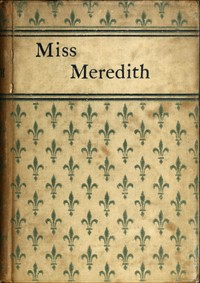
Miss Meredith — Edition Insights
19
3
Project Gutenberg
2019
Governesses -- Fiction; British -- Italy -- Fiction; Man-woman relationships -- Fiction; Pisa (Italy) -- Fiction
Readers of public-domain and historical texts
Project Gutenberg digital edition
en
Edition facts
Words: 26,471
Reading time: 116 min
Text sections: 3
Source:
Project Gutenberg record #59990
Amy Levy's Miss Meredith follows Elsie Meredith, a self-described 'neither literary nor artistic' governess in Pisa, through a first-person narrative marked by self-deprecating wit, sharp observations of family dynamics, and the tension between English reserve and Italian exuberance.
Editorial Edition Score
4.5/5
★★★★★
★★★★★
Calculated from edition completeness, EPUB availability, text structure and catalogue metadata. Not a user rating.
Edition quality
From its first paragraph, Miss Meredith establishes a narrator who defines herself by what she is not. Elsie Meredith introduces her family by cataloguing each member's talent—Jenny's watercolours, Rosalind's proofs and B.A.—before arriving at her own 'middle place' and 'mediocrity.' This self-deprecating voice, precise and slightly wry, governs the novel's tone. Levy builds the Meredith household through small, telling details: the lamp's rays on Jenny's Titian-coloured hair, the widow's cap on the mother, the proof-sheets from Temple Bar. The scene is domestic, constrained, and economically sketched. When the narrative moves to Italy, the same observant eye turns on new surroundings, but Elsie's habit of measuring herself against others—and against her own expectations—remains constant.
A Self-Deprecating First-Person Voice
Elsie Meredith narrates in a register that is conversational, confiding, and frequently ironic. She describes herself as 'pale and ugly' during a low period, then notes that her cheeks are 'red enough to-night'—'only red from crossness.' The self-awareness is sharp but not self-pitying. When she catches herself taking unusual interest in her appearance, she attributes it to 'the infection from that middle-aged Costanza.' Levy uses this voice to create intimacy while also signalling Elsie's unreliability as a judge of her own worth. The narrator's asides—'It is all very well to be Cinderella, if you happen to have a fairy-godmother'—reveal a pragmatic, slightly cynical intelligence beneath the modest surface.
Family Dynamics Through Detail
The opening chapter economically establishes a family hierarchy based on accomplishment. Rosalind is 'the genius,' Jenny 'picturesque,' while Elsie occupies a 'middle place' that she interprets as mediocrity. Levy does not state the mother's sacrifices; instead, she shows her 'bent over the sewing' by the fire, her face 'worn, serene, and gentle.' The mother's history—marrying for love, facing 'poverty and sickness'—is compressed into a single paragraph. Later, when Elsie dances alone in the ballroom, humming 'Dream Faces,' the moment reads as both a release from family roles and a continuation of her self-consciousness: she is caught by Andrea and blushes 'deeply.'
Contrasts of English and Italian Manner
Levy sets English restraint against Italian expressiveness through small behavioural cues. Andrea speaks in 'soft, sweet Italian tones' mixed with 'very pronounced American accent' and 'flowers of American idiom.' He finds the beautiful ballroom 'gloomy'; Elsie thinks it 'desecration to dance in it.' Their exchange about the floor—she tests it critically, he watches—captures a cultural gap in how pleasure and formality are regarded. Costanza Marchetti, mentioned only in passing, is labelled 'middle-aged' with a 'spiteful' edge, hinting at rivalries that the excerpts do not fully develop. The setting itself—a faded, tapestry-hung palazzo—becomes a third character, its 'severe beauty' a backdrop for collisions of temperament.
The Unreliable Self-Portrait
Elsie's self-assessment is consistently contradicted by the evidence of the text. She claims to be 'neither literary nor artistic,' yet her narration is full of literary allusion and painterly observation: the 'aureole of Titian-coloured hair,' the 'faded tapestry, of good design and soft dim colour.' She insists she is 'pale and ugly,' but others find her attractive; Andrea smiles back 'most' warmly. Levy creates a narrator whose words and actions diverge, inviting the reader to see more than Elsie sees in herself. This technique gives the novel its psychological interest: the story is not only about events in Pisa but about the gap between Elsie's self-image and the person she actually is.
Levy's prose rewards attention to its small, precise choices: the way a character's idiom reveals background, the weight given to a gesture or a piece of clothing, the narrator's habit of undercutting her own observations. Readers will find that Elsie's voice—self-mocking, observant, and occasionally blind—shapes the story as much as any plot event. The excerpts offer a clear sense of that voice, though the full arc of the romance and Elsie's development remains to be discovered in the complete novel.
Reader reflection
Your personal reading reflection
Build a private reading journal entry for this title.
Your progress
0
/
10
2
Did this book hold your interest?
3
Would you encourage someone else to read it?
4
How easy was the book to follow?
5
Did it raise ideas you would like to talk about?
6
Was the book what you thought it would be?
7
Did any part of the book stay with you emotionally?
8
Do you expect to return to this book?
9
What did this book teach you most?
10