1

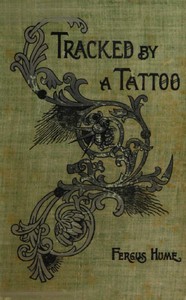
Tracked by a Tattoo: A Mystery — Themes and Context
18
2
Project Gutenberg
2017
Detective and mystery stories; London (England) -- Fiction; Murder -- Investigation -- Fiction
Readers of public-domain and historical texts
Project Gutenberg digital edition
en
Edition facts
Words: 85,251
Reading time: 371 min
Text sections: 10
Source:
Project Gutenberg record #55783
Fergus Hume's 1897 mystery follows detective Fanks as he investigates a murder linked to a tattoo, navigating a web of lies, photographs, and a paralyzed witness. The excerpts reveal tense interrogations and a cleverly staged accident to uncover a hidden portrait.
Fergus Hume's Tracked by a Tattoo: A Mystery opens with detective Fanks in a tense interview with Mrs. Colmer, a paralyzed woman whose daughter Anne is a suspect. The scene is built around small, telling details: a shawl of Chinese crape, an open Bible, a pile of photographs at Mrs. Colmer's elbow. Fanks's feigned stumble to knock over the table and examine the pictures is a precise, almost theatrical maneuver, revealing his methodical cunning. The discovery of a photograph of Mrs. Boazoph—a character whose significance is not yet explained—introduces a layer of hidden connections. The dialogue between Fanks and Anne Colmer is sharp, with Anne openly admitting she would lie if it served her purpose. This early excerpt establishes a world where appearances are deliberately misleading, and every object, from a photograph to a stumble, carries potential evidence.
The Paralysis of Truth and Mobility
Mrs. Colmer's physical paralysis is more than a plot device; it mirrors the stalled investigation. She is confined to her chair, unable to move hand or foot, yet she is surrounded by photographs that may hold the key to the mystery. Fanks's observation that there is no photograph of the dead Emma in the room—only a pile at his hostess's elbow—suggests that the truth is literally within reach but inaccessible. The detective's pretended stumble is a physical act of breaking this stasis, but what he finds (Mrs. Boazoph's portrait) only deepens the puzzle. Anne's quick intervention to silence him and her mother's passive compliance highlight how immobility extends beyond the physical: characters are trapped by their own secrets and loyalties.
Photographs as Evidence and Deception
Photographs in this excerpt are not mere keepsakes but contested objects of proof. Anne claims no photograph of Emma exists except the one she sought at Sir Gregory's chambers, yet Fanks suspects another is hidden in Mrs. Colmer's pile. The detective's search is a game of concealment and revelation: he knocks over the table to gain access, but the photograph he finds is not the one he expected. This misdirection underscores the unreliability of visual evidence. The photograph of Mrs. Boazoph introduces a new thread, linking characters in ways not yet clear. Hume uses the photograph as a tangible clue that shifts meaning depending on who holds it and what they choose to reveal.
Anne Colmer's Calculated Defiance
Anne Colmer emerges as a formidable opponent to Fanks. Her dialogue is marked by coolness and directness: she admits she would lie for gain, yet claims to have nothing to hide in this instance. She takes control of the scene, drawing Fanks away from her mother and into another room, and she immediately addresses the photograph in his hand. Her statement that she persuaded Mr. Hersham to tell all suggests she is manipulating events behind the scenes. The mutual distrust between her and Fanks is palpable—they look into each other's eyes, and a challenge passes unspoken. Anne's defiance is not emotional but calculated, making her a complex figure whose motives remain ambiguous.
Readers should pay close attention to the physical objects and gestures in the early chapters: a shawl, a Bible, a pile of photographs, a stumble. Hume builds his mystery through such concrete details rather than abstract clues. The tension between what characters say and what they do—Anne's claim of honesty versus her admitted willingness to lie—creates a layered puzzle. The excerpts offer no resolution, only a web of connections waiting to be untangled.
Reader reflection
What did you think of this book?
Answer a few questions and save a private reflection on this device.
Your progress
0
/
10
2
How did the book work for you overall?
3
How likely are you to recommend this book?
4
How easy was the book to follow?
5
How would you rate its originality?
6
Was the book easy to understand?
7
Did the story or argument move comfortably?
8
How did the reading compare with what you expected?
9
What changed or sharpened your thinking?
10