1

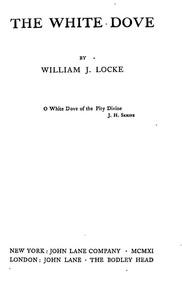
The White Dove — Key Ideas to Explore
13
2
Project Gutenberg
2017
Adultery -- Fiction; England -- Fiction; Man-woman relationships -- Fiction; Families -- Fiction
Readers of public-domain and historical texts
Project Gutenberg digital edition
en
Edition facts
Words: 76,641
Reading time: 334 min
Text sections: 10
Source:
Project Gutenberg record #56013
In William J. Locke's 1899 novel, a young woman's declaration that 'life is a glorious thing' sets up tensions between idealism and practicality, as artist Roderick schemes to abandon a utopian colony and Sylvester Lanyon navigates conflicting loyalties.
Editorial Edition Score
4.7/5
★★★★★
★★★★★
Calculated from edition completeness, EPUB availability, text structure and catalogue metadata. Not a user rating.
Edition quality
The novel opens with a pointed exchange: Ella Defries declares 'Life is a glorious thing,' and Sylvester Lanyon counters with a wry skepticism. This initial clash of outlooks—between youthful conquest and weary resignation—echoes throughout the excerpts. Locke establishes a pattern of characters speaking past one another, their words carrying unspoken weight. Ella's 'sweet insolence' and Sylvester's inability to frame a compliment reveal a social dance of self-consciousness and restraint. The setting of Woodlands, a room furnished with 'solid mahogany and leather of a bygone generation,' becomes a stage for these tensions, where private thoughts are half-spoken and motives remain veiled.
Voices of Deflection and Unspoken Intent
Locke's dialogue often operates on two levels: what is said and what is left unsaid. When Sylvester remarks that a woman is 'always ten years older than a man,' Ella's response—'That you ought to go into the world and win fame'—sidesteps his implied compliment. The narrative notes her 'self-conscious glance' and his inability to express graceful words, highlighting a pattern of emotional evasion. Similarly, Roderick's confession to Sylvester about the Colony's failure is laced with bravado: he laughs loudly, then admits his father will leave nothing to him. The prose reports his 'burst of confidence' and subsequent shame, but the reader is left to infer the depth of his desperation. These moments of deflection create a texture of unspoken tension, where characters reveal themselves through what they do not say.
The Colony as a Shifting Symbol
The Walden Art Colony functions as a contested idea rather than a fixed place. For Ella, it represents a 'forlorn hope' she defends fiercely when her aunt mocks it. For Roderick, it is a 'fixed income' he abandons when it no longer serves his interests; he later despises it as 'an inane chimera.' The narrative tracks his internal reversal: he had 'deluded himself' into believing in it, then 'regarded it dispassionately' and found it worthless. This shift mirrors the novel's broader concern with idealism versus practicality. The Colony's fate remains uncertain in the excerpts—Roderick vows to restart it at Christmas, but his earlier sabotage has alienated supporters. Locke uses the Colony as a litmus test for character, revealing how each person's commitment waxes and wanes with personal stakes.
The Weight of Unspoken Decisions
Ella's inner state is described in abstract, almost spectral terms: she becomes 'a vague entity wandering in a land of shadows,' with her only hope 'one elusive light that gleamed fitfully.' This language contrasts sharply with the concrete social world of visits and sewing. Her aunt, Lady Milmo, notices 'the habitual contraction of her brow' and consults Sylvester, but the excerpts do not reveal what decision Ella faces. Roderick, meanwhile, is 'a prey to gnawing anxiety' over replacing three thousand pounds—a sum whose origin and purpose are left unclear. The narrative withholds key information, forcing the reader to piece together motives from gestures and half-revelations. This technique of strategic ambiguity gives the novel a psychological density, where the most important conflicts simmer beneath polite conversation.
Readers should attend to the novel's use of indirect revelation: characters often disclose their true feelings through actions or silences rather than direct statements. The recurring motif of the 'White Dove' from the epigraph may offer a symbolic key, but its meaning unfolds gradually. Locke's prose rewards close attention to shifts in tone—from Ella's flushed defiance to Roderick's theatrical self-pity. The incomplete excerpts leave the Colony's fate and Ella's choice unresolved, inviting speculation about how these threads will converge.
Reader reflection
How did this book work for you?
Your answers remain private and are stored only in this browser.
Your progress
0
/
10
2
Was reading this book enjoyable?
3
Is this a title you would suggest to others?
4
How easy was the book to follow?
5
How did the pace of the book feel?
6
What was its emotional impact?
7
How valuable was this book for your own interests?
8
Did you relate to its people, ideas, or situations?
9
What did this book teach you most?
10