1

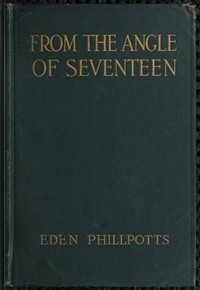
From the Angle of Seventeen — A Closer Reading
18
3
Project Gutenberg
2017
London (England) -- Fiction; Clerks -- Fiction; Aunts -- Fiction; Teenagers -- Fiction
Readers of public-domain and historical texts
Project Gutenberg digital edition
en
Edition facts
Words: 50,941
Reading time: 222 min
Text sections: 15
Source:
Project Gutenberg record #55821
Eden Phillpotts' 1912 novel follows teenager Corkey Major from school to a London clerkship, using his first-person voice to contrast youthful perspective with adult expectations, as seen in the opening scene with the Doctor and later elocution lessons.
Editorial Edition Score
4.7/5
★★★★★
★★★★★
Calculated from edition completeness, EPUB availability, text structure and catalogue metadata. Not a user rating.
Edition quality
The novel opens with a direct, colloquial voice: 'When the Doctor sent for me to his study, I hoped it was about the fireworks, because I was head boy that term.' This sentence immediately establishes the narrator, Corkey Major, as a teenager whose concerns—fireworks, status—are about to be upended. The Doctor's formal language ('a missive from your maternal aunt') clashes with Corkey's casual tone, setting up a central tension between youthful perspective and adult authority. The excerpt shows Phillpotts using the first-person angle to filter all events through Corkey's limited but earnest understanding, a technique that shapes the entire narrative.
A Voice Between Schoolboy and Clerk
Corkey's narration is marked by specific, unpretentious observations. He notes that being asked to sit down is 'a startler' because the Doctor 'never asked anybody to sit down except parents or guardians.' This detail reveals Corkey's social awareness and his habit of reading adult behavior through a schoolboy's code. The language is consistently idiomatic: 'you bossed the fireworks,' 'bang out of his stride.' Phillpotts avoids adult retrospection; Corkey reports events as they happen, with immediate reactions rather than mature reflection. The shift from school to a clerkship at the Apollo Fire Office is presented not as a grand transition but as a practical disruption, with the Doctor's speech about 'the great industrial centers of finance' sounding pompous against Corkey's plainspoken summary.
Comic Disjuncture in the Elocution Scene
A later excerpt introduces Mr. Merridew, an elocution teacher whose theatrical rhetoric—'the wings of the angel of pity'—is undercut by Corkey's deadpan reporting. The scene where Mr. Smith recites Shelley's 'To a Skylark' becomes a study in failed performance: Smith drops his h's (''Ail to thee, blithe spirit'), and when he 'stood on his toes and fluttered his arms,' Corkey notes it 'might have answered fairly well for a turkey.' Phillpotts uses Corkey's literal-mindedness to expose the gap between artistic pretension and clumsy reality. The humor arises not from mockery but from the narrator's inability to see the pathos—he feels 'rather sad' for Smith, but his description remains concrete. This scene also hints at the novel's interest in how people perform roles, whether on stage or in the office.
Pace and the Rhythm of Daily Life
The excerpts suggest a narrative that alternates between brisk, event-driven passages and slower, observational ones. The opening moves quickly: the summons, the news, the exam deadline—all within a few paragraphs. But the elocution scene unfolds at a more deliberate pace, dwelling on Mr. Merridew's speech and Mr. Smith's recitation. Phillpotts uses Corkey's attention span to modulate tempo: when the narrator is engaged (fireworks, his own fate), the prose accelerates; when he is a spectator (the elocution class), it lingers on details. This variation mirrors a teenager's uneven focus. The novel's structure, with 15 text sections, likely follows Corkey's movement between home, work, and leisure, each shift bringing a change in narrative rhythm. Readers should watch for how the pace reflects Corkey's emotional state—whether he is anxious, bored, or curious.
Readers approaching From the Angle of Seventeen should attend to the gap between what Corkey reports and what he understands. Phillpotts rarely signals irony directly; instead, the humor and pathos emerge from the reader's recognition of the narrator's limitations. The novel rewards attention to small details—a dropped h, a fluttered arm—that reveal character and social comedy. The first-person angle is not just a viewpoint but the book's central subject: the process of learning to see beyond one's own perspective.
Reader reflection
Your personal reading reflection
Build a private reading journal entry for this title.
Your progress
0
/
10
2
What was your overall reaction to the book?
3
Would you recommend this book to another reader?
4
How easy was the book to follow?
5
Did anything about the book feel genuinely new?
6
How clearly were the main ideas presented?
7
Did the book give you something worth debating?
8
How personally connected did you feel to the book?
9
What did this book teach you most?
10