1

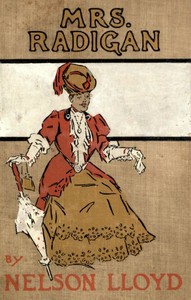
Mrs. Radigan: Her Biography, with that of Miss Pearl Veal, and the Memoirs of J. Madison Mudison — Text and Context
18
5
Project Gutenberg
2017
New York (N.Y.) -- Fiction; Satire; Social classes -- Fiction; Women -- Conduct of life -- Fiction
Readers of public-domain and historical texts
Project Gutenberg digital edition
en
Edition facts
Words: 62,721
Reading time: 273 min
Text sections: 6
Source:
Project Gutenberg record #55678
A satirical novel told through three interwoven narratives, chronicling Mrs. Radigan's social ascent in New York high society, with recurring motifs of performance, social climbing, and the absurdities of class.
Editorial Edition Score
4.7/5
★★★★★
★★★★★
Calculated from edition completeness, EPUB availability, text structure and catalogue metadata. Not a user rating.
Edition quality
The novel opens with a first-person narrator who, fresh from college athletic fame, dreams of lasting renown beyond the gridiron. This voice—self-deprecating, observant, and ironic—guides the reader through a world of horse shows, opera boxes, and cotillons. The narrative structure is immediately striking: the first chapter is titled "The First Chapter and the Last," hinting at a circular or self-aware design. The story unfolds through three distinct sections: Mrs. Radigan's biography, Miss Pearl Veal's story, and the memoirs of J. Madison Mudison. Each section offers a different perspective on the same social milieu, creating a layered portrait of ambition and pretension.
A Tripartite Structure and Shifting Perspectives
The book's full title announces its unusual structure: three separate accounts bound together. The first and longest section is narrated by an unnamed young man who becomes Mrs. Radigan's social secretary and chronicler. His tone is wry and self-mocking, as when he recalls his college fame and admits, "I did want something more lasting." The second section shifts to Miss Pearl Veal, a character introduced through the narrator's eyes, but whose own voice emerges in later chapters. The third section presents the memoirs of J. Madison Mudison, a different narrator whose perspective on events overlaps with and sometimes contradicts the earlier accounts. This fragmentation allows the reader to see the same social maneuvers—dinners, dances, the arrival of a British duke—from multiple angles, revealing how each participant interprets the same events differently.
Recurring Images: The Carriage, the Opera Box, the Costume Ball
Certain images recur throughout the excerpts, anchoring the social world in physical details. Carriages appear repeatedly: the narrator watches "the endless stream of carriages rolling along the drive-way," and a "smart brougham" signals the arrival of the Bumpschus carriage. The opera box is another repeated setting, as chapter titles like "In the New Box at the Opera" and "Mr. Mudison Sees Mrs. Underbunk at the Opera" indicate. Costume balls and cotillons are frequent backdrops, with one chapter devoted entirely to "Mrs. Radigan's Costume-ball." These recurring locations and objects—carriages, opera boxes, ballrooms—serve as stages for social performance. The narrator's eye for detail, such as the "Frenchmen on the box" of a carriage, underscores the importance of appearances and the careful orchestration of status.
Movement Between Scenes: From Westbury to the Races
The narrative moves briskly between settings, often signaled by chapter titles that indicate a change of scene: "A Week-end at Westbury," "We Go Skating at Exudo," "At the Races." These shifts are not merely geographical but social, as each location carries its own codes of behavior. The country weekend at Westbury contrasts with the urban opera box; the skating outing at Exudo offers a more informal, athletic setting. The narrator's commentary often highlights the absurdity of these transitions, as when he notes that Sir Charles Wigge, the English solicitor, treats America as a colonial outpost, remarking that "an Englishman adapts himself to his circumstances" whether in a "Zulu kraal or in America." The movement between scenes thus reinforces the theme of social performance, as characters must adjust their roles to fit each new environment.
Voice and Irony: The Narrator's Self-Awareness
The narrator's voice is the novel's most consistent feature. He is acutely aware of his own social position and the absurdities around him. He describes himself as a former athlete now adrift, and his observations are tinged with irony. When Sir Charles Wigge arrives, the narrator notes that "he looks like Zeus shaved" and that Mrs. Radigan becomes "abject" in his presence. The narrator's dry humor extends to his own role: he is both participant and observer, a social secretary who records the foibles of his employers. His commentary on the Duke of Nocastle's refusal to play bridge for more than a ha'penny a point, and the subsequent argument over American versus English coinage, reveals the trivial yet charged nature of social interactions. This ironic distance prevents the novel from becoming mere satire; it remains grounded in a recognizable, if exaggerated, social reality.
Readers should pay attention to the way the three narratives echo and contradict each other. The same event—such as the arrival of the Duke of Nocastle—is described differently by the narrator and by Mr. Mudison, revealing how social status shapes perception. The novel rewards careful reading of these shifts in perspective, as well as the recurring motifs of carriages, opera boxes, and balls. The humor is dry and understated, often emerging from the narrator's deadpan observations rather than overt jokes.
Reader reflection
How did this book work for you?
Your answers remain private and are stored only in this browser.
Your progress
0
/
10
2
What was your overall reaction to the book?
3
Would you encourage someone else to read it?
4
How demanding did the text feel?
5
Is this a title worth rereading?
6
How strongly did the book affect you emotionally?
7
Could you follow the author’s main argument?
8
Did the book deliver what you hoped for?
9
Which lesson or insight stayed with you?
10