1

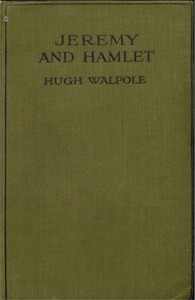
Jeremy and Hamlet A Chronicle of Certain Incidents in the Lives of a Boy, a Dog, and a Country Town — Story, Setting & Ideas
4
2
Project Gutenberg
2019
England -- Social life and customs -- 19th century -- Fiction; Dogs -- Fiction; Boys -- Fiction
Readers of public-domain and historical texts
Project Gutenberg digital edition
en
Edition facts
Words: 72,056
Reading time: 314 min
Text sections: 8
Source:
Project Gutenberg record #60325
Hugh Walpole's 1923 novel follows young Jeremy Cole and his dog Hamlet in the fictional English town of Polchester, circa 1894. The excerpts reveal a basement window framing cathedral towers, a cricket match where the outcast Baltimore bowls 'sneaks,' and a narrative voice that contrasts canine sensory life with human social hierarchies.
Editorial Edition Score
4.7/5
★★★★★
★★★★★
Calculated from edition completeness, EPUB availability, text structure and catalogue metadata. Not a user rating.
Edition quality
The first chapter places Hamlet, a square-bodied dog with a 'peaked beard' and 'Christmas-tree tail,' on a shelf between kitchen and pantry. Walpole anchors the animal's perspective in sensory detail—ears stretched for cook's movements, nostrils distended for food—while his eyes fix on the 'passing show' beyond a basement window that offers a glimpse of Polchester's Cathedral Towers. This window, almost level with iron railings, becomes a threshold between the dark, cabbage-smelling basement and the wider world of 1894 provincial England.
The narrative voice is wry and precise, noting that only 'very high-bred and in-bred dogs are conscious philosophers.' Hamlet's attention is split between stomach and spectacle, a tension that sets the tone for a chronicle where human dramas unfold with similar divided loyalties.
A Cricket Match and the Outcast's Skill
The excerpts include a cricket game in 'third game' where the unpopular Baltimore asks to bowl. The master, Newsom, wearily agrees: 'Oh, I suppose so; anything for a change.' Baltimore's delivery is described with sudden transformation: 'A new spirit inhabited the boy’s body. Something seemed suddenly to stiffen him; his legs were no longer shambly, his eyes no longer dead.' He bowls an underhand lob that takes Corkery's wicket, then three more wickets in succession, including Jeremy's.
The other boys dismiss the balls as 'sneaks,' and Baltimore is later beaten with hair-brushes in the box-room. Yet Walpole emphasizes that Baltimore 'took his beating without a word' and afterward 'held up his head, occasionally washed his face, and stared superciliously about him.' Jeremy, who has been protective of Baltimore, watches his friend's first appearance in 'second game' with a pride he cannot explain to Riley, who demands he choose between them.
The Dog's Window and the Town's Geography
Walpole establishes Polchester through the basement window's view: 'down over Orange Street and, obliquely, sharp to the right and past the Polchester High School, a glimpse of the Cathedral Towers themselves.' This specific geography anchors the domestic interior within a larger social landscape. The basement itself is described as 'dark, chill, odourful caverns hissing with ill-burning gas and smelling of ill-cooked cabbage,' a sensory portrait of 1890s provincial life.
Hamlet's position on the shelf is both literal and symbolic—he is above the kitchen floor but still below street level, watching 'the pageantry, the rough-and-tumble of the world.' The narrative shifts between the dog's limited consciousness and the human events that unfold beyond the window, creating a layered perspective on the town's routines and hierarchies.
Voice and Structure: Chronicles and Interiors
The subtitle announces the book as 'A Chronicle of Certain Incidents in the Lives of a Boy, a Dog, and a Country Town,' and the chapter titles—'Come out of the Kitchen,' 'Conscience Money,' 'The Night Raiders'—suggest episodic, incident-driven storytelling. The excerpts show a narrator who moves between close observation of physical details (Hamlet's 'joint-leg' like a wooden toy) and dry commentary on social dynamics.
The cricket episode, for instance, is less about the game than about status: Baltimore's skill disrupts the established order, and the masters' indifference ('Newsom pulled himself in from his dreams') contrasts with the boys' casual cruelty. Walpole's prose is concrete, avoiding sentimentality even when describing the dog's 'sad and mysterious' eyes. The chronicle form allows for digressions into character and setting without a tightly plotted arc.
Readers should attend to the way Walpole uses physical spaces—the basement window, the cricket pavilion, the box-room—to map social boundaries. The dog Hamlet is not anthropomorphized into a thinker but remains a creature of appetite and instinct, yet his watchful presence frames the human action. The excerpts leave Baltimore's story unresolved; his sudden competence and subsequent punishment suggest a pattern of talent met with suspicion, but the full chronicle may develop this thread further.
Reader reflection
Your personal reading reflection
Build a private reading journal entry for this title.
Your progress
0
/
10
2
What was your overall reaction to the book?
3
Is this a title you would suggest to others?
4
How much effort did this book require?
5
Would you read this book again?
6
Which part made the strongest impression?
7
How did the reading compare with what you expected?
8
Would this book work well in a reading group?
9
What did this book teach you most?
10