1

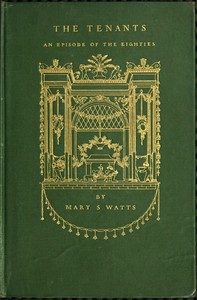
The Tenants: An Episode of the '80s — Themes and Context
27
7
Project Gutenberg
2019
Ohio -- Social life and customs -- Fiction; Dwellings -- Fiction; Families -- Fiction
Readers of public-domain and historical texts
Project Gutenberg digital edition
en
Edition facts
Words: 94,976
Reading time: 413 min
Text sections: 9
Source:
Project Gutenberg record #59640
A first-person narrative traces the decline of a once-grand Ohio mansion from boarding-house to tenement, weaving together the lives of its eccentric tenants in the 1880s. The novel's structure moves between past and present, using the house's demolition as a framing device.
The novel opens with the demolition of the old Gwynne house, a building that has passed from historic landmark to boarding-house to tenement. The narrator, a former resident, recalls the house's heyday and its slow decay, setting up a structure that moves between the present of the 1900s and the past of the 1880s. This framing device allows the story to unfold as a series of episodes centered on the house's inhabitants, from the eccentric Doctor Vardaman to the aspiring actor Huddesley.
The narrative voice is conversational and observant, often addressing the reader directly. The house itself becomes a character, its physical changes mirroring the social shifts of the era. The opening establishes a tone of sentimental regret tempered by wry humor, as the narrator describes the house's journey from pompous seclusion to a common drudge.
The House as a Stationary Odysseus
The narrator whimsically calls the Gwynne house a “stationary Odysseus,” suggesting it has undergone a whole epic of adventures without moving. This metaphor is apt: the house endures changes in fortune, from a governor's mansion to a tenement, while its physical structure remains. The description of the Parthenon front with Doric pillars hints at a classical pretension that contrasts with its later sordid state. The house's history is told through its architecture—the brick walls, the stone ribbon, the elm and buckeye trees that retain an air of antique dignity amidst factory whistles. The narrator's eye for detail, such as the black-and-white pavement, grounds the story in a specific, tangible setting.
Voices and Social Hierarchies
The excerpt introduces a diverse cast through dialogue that reveals class and education. Doctor Vardaman's speech is brisk and educated, while Mrs. Botlisch's is blunt and colloquial. Huddesley, the butler, adopts a stagey, aspirational tone: “Hi feel the stirrin' of Hart within my buzzom.” His use of “Hart” with a capital H—corrected by the doctor—shows his attempt to elevate himself through language, borrowed from books. The doctor's amusement at Huddesley's pretensions is tempered by J. B.'s observation that it's “pathetic too.” This moment captures the novel's interest in social mobility and the gap between aspiration and reality. The characters' voices are distinct, and their interactions often hinge on misunderstandings of class and education.
Recurring Images of Decline and Transformation
The demolition of the house is the central image, but the text also dwells on smaller transformations: the park turned into building-lots, the cottage replaced by an apartment-house. The narrator notes that the ground has been “reclaimed from slums and shanties,” a phrase that suggests both improvement and loss. The house's journey from “historic landmark” to “common drudge” is mirrored in the characters' own declines or aspirations. Doctor Vardaman's procession of lazy, drunken servants contrasts with Huddesley's desire to be an actor. The image of the butler reading with a feather duster under his arm recurs, symbolizing hidden intellect. These recurring details—the house's decay, the servants' failures, the characters' thwarted ambitions—create a pattern of decline that is both specific to the 1880s and universal.
Movement Between Scenes and Perspectives
The narrative moves fluidly between the present of the demolition and the past of the boarding-house. The opening paragraph shifts from the “other day” to “in my time,” establishing a layered temporality. Within the past scenes, the point of view is that of the narrator, who observes and remembers. The excerpt includes a long dialogue scene in Doctor Vardaman's room, where the conversation moves from Huddesley's aspirations to Mrs. Botlisch's cynical remarks. The narrator notes that “at least two people in the room looked at the young man with a quicker interest,” signaling shifts in attention. This technique—using the narrator's memory to jump between moments—gives the novel a episodic, reflective quality. The structure is not linear but associative, held together by the house and the narrator's voice.
The novel rewards attention to its framing device and the narrator's selective memory. The house's demolition is not just a backdrop but a lens through which the characters' stories are filtered. Readers may find it useful to note how each episode connects to the physical spaces of the house—the doctor's room, the garden, the driveway—and how the narrator's tone shifts between nostalgia and irony. The incomplete excerpts leave the full arc of the characters unclear, but the patterns of aspiration and decline are already evident.
Reader reflection
How will you remember this book?
Save your reaction, strongest insight, and memorable passage.
Your progress
0
/
10
2
How much did you enjoy the reading experience?
3
How likely are you to recommend this book?
4
What was the reading difficulty like?
5
How did the pace of the book feel?
6
How understandable was the text?
7
How strong was your personal connection to the text?
8
Did you gain anything practical from the text?
9
What did this book teach you most?
10