1

Peradventure; or, The Silence of God — Context and Discussion
4
2
Project Gutenberg
2017
Church of England -- Fiction; Young men -- Fiction; Religion -- Fiction
Readers of public-domain and historical texts
Project Gutenberg digital edition
en
Edition facts
Words: 105,502
Reading time: 459 min
Text sections: 9
Source:
Project Gutenberg record #55994
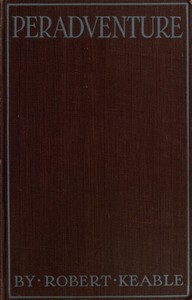
Robert Keable's 1922 novel follows Paul Kestern, a young clergyman questioning faith and vocation. The narrative moves between England and abroad, using recurring images of silence, prayer, and the natural world to explore doubt and desire. The dedication frames the novel as a theological inquiry in fictional form.
Editorial Edition Score
4.8/5
★★★★★
★★★★★
Calculated from edition completeness, EPUB availability, text structure and catalogue metadata. Not a user rating.
Edition quality
Robert Keable’s Peradventure; or, The Silence of God opens with a dedication that explicitly frames the novel as a theological inquiry cast in fictional form. Keable writes to a friend who has become a Catholic priest, noting that “man’s thoughts about God are read best in a novel.” The title itself, drawn from 1 Kings xviii. 27, signals a central preoccupation: the apparent silence of God in human affairs. The excerpts reveal a work structured around movement between scenes—from a girl’s private prayers to a moonlit drive through the Midlands—and recurring images of night, stars, and the voiceless cry of the world.
A Novel of Theological Inquiry
The dedication to “Christopher” is not a mere courtesy; it establishes the book’s method. Keable contrasts the novel with a “book of serious theology,” arguing that fiction can capture the inseparable nature of man and God. He writes that “we have no medium other than the human brain by which to think of Him,” and that the novel’s “transitory frivolous form” is paradoxically the truest vessel for profound thought. This framing invites the reader to treat the ensuing narrative as a deliberate experiment: can a story about a young man’s doubts and relationships carry the weight of a theological argument? The excerpts suggest that Keable answers in the affirmative, weaving abstract questions into concrete scenes of domestic prayer and nocturnal travel.
Recurring Images: Silence, Night, and the Natural World
Throughout the excerpts, silence and darkness are not mere atmosphere but active presences. The girl at prayer kneels “a little more slowly than usual,” and the narrative notes that “dancing and drinking and praying never cease altogether, nor does the voiceless cry of the world ever cease to echo through the silences.” This phrase echoes the novel’s subtitle. Later, Paul’s arrival at a country station is described under “frosty stars,” with a small moon “swung up and down over them like a child’s toy.” The driver lapses into “monotonous silence.” These details accumulate into a pattern: the natural world is both a backdrop and a participant in the characters’ spiritual struggles, its rhythms contrasting with human restlessness.
Movement Between Scenes: From Interior to Landscape
The excerpts show a deliberate structure of shifting settings. The first excerpt moves from a girl’s bedroom—where she kneels, prays, and “gashed herself with great horrid knives of renunciation”—to a broader view: “the pall of deep night settled down on half the world.” Then the narrative cuts to a railway station, a dog-cart ride, and the open country. This juxtaposition of intimate interiority with expansive landscape is a recurring technique. The girl’s halting, half-formed prayers are set against the steady trot of a horse and the “steam of his exertion” rising in the lamplight. The effect is to suggest that personal doubt and desire unfold within a larger, indifferent cosmos—a key concern of the novel’s theological inquiry.
The Voice of the Epigraph and Chapter Headings
The novel’s epigraph from 1 Kings—“He is a god; peradventure he sleepeth”—is reinforced by the chapter heading for Chapter VII, which quotes John Masefield’s Good Friday. The lines speak of “wild souls of men” who find “no peace” and face “the spitting mob, the cross, the crown of thorns.” This poetic intrusion signals that the narrative will not shy from suffering or doubt. The chapter then opens with Paul’s arrival at a country station, a mundane scene that is immediately charged with the epigraph’s weight. Keable uses these framing devices to remind the reader that the story is part of a longer tradition of questioning divine silence, and that the characters’ struggles are not merely personal but emblematic.
Character and Consciousness: The Girl’s Prayer
The extended passage of a girl’s night prayer offers a rare window into a character’s inner life. She does not want to be a clergyman’s wife, but cannot tell God that; she wants to be a successful author’s wife, but cannot tell God that either. Her prayer is a muddle of conventional piety and genuine longing: “Make Paul love me, O God,” she whispers. The narrative voice is precise about her limitations—“her soul, not very big, at the best”—yet treats her with sympathy. This scene, set against the novel’s larger theological concerns, suggests that Keable is interested in how ordinary people grapple with faith and desire, and how their halting prayers are part of the “voiceless cry” that the novel explores.
Peradventure; or, The Silence of God rewards attention to its structure of contrasts: between interior monologue and external landscape, between silence and speech, between the mundane and the eternal. Readers may find that the novel’s power lies less in plot than in these juxtapositions, which Keable uses to stage a theological argument without ever abandoning the texture of everyday life. The excerpts suggest a work that is both intimate and ambitious, grounded in specific settings yet reaching toward the universal.
Reader reflection
How will you remember this book?
Save your reaction, strongest insight, and memorable passage.
Your progress
0
/
10
2
How much did you enjoy the reading experience?
3
Is this a title you would suggest to others?
4
How much effort did this book require?
5
Is this a title worth rereading?
6
Did the book meet your expectations?
7
Did the book give you something worth debating?
8
Which aspect of the book did you value most?
9
What did this book teach you most?
10