1

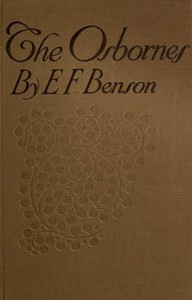
The Osbornes — A Reader’s Guide
14
4
Project Gutenberg
2019
Marriage -- Fiction; England -- Social life and customs -- 20th century -- Fiction; Families -- Fiction; Social classes -- England -- Fiction
Readers of public-domain and historical texts
Project Gutenberg digital edition
en
Edition facts
Words: 105,619
Reading time: 460 min
Text sections: 9
Source:
Project Gutenberg record #58884
Benson's novel traces the social ascent of the Osborne family through precise diction, dialogue, and descriptive choices that reveal the tensions between ambition, class, and physical decline in early 20th-century England.
Editorial Edition Score
4.8/5
★★★★★
★★★★★
Calculated from edition completeness, EPUB availability, text structure and catalogue metadata. Not a user rating.
Edition quality
From its first sentence, The Osbornes announces a house that is 'the newest and whitest and most pretentious and preposterous' in Park Lane—a cascade of adjectives that signals Benson's eye for the comic and the critical. The opening scene, a lavish party with every window blazing, immediately establishes the Osbornes' desire for display and the narrator's wry detachment. The butler Thoresby, once called 'Willum' as a boot boy, embodies the family's rapid rise, his name changes charting their social climb. Benson uses such details not as mere decoration but as precise indicators of character and milieu.
Diction as Social Barometer
Benson's word choices do more than describe; they judge. The house is not merely large but 'pretentious,' a term that colors the entire enterprise. Mrs. Osborne's slip between 'Willum' and 'Thoresby' reveals her lingering insecurity despite her wealth. The narrator notes that she 'had probably forgotten that there existed such officers as boot boys'—a dry observation that underscores how quickly the family has left its origins behind. Similarly, Mr. Osborne's musings on titles—'Lord Hardware, Tinware'—expose the absurdity of grafting a peerage onto a commercial fortune. These lexical choices create a world where language itself is a marker of class, and every word carries social weight.
Dialogue and the Unspoken
The excerpted dialogue between Mr. and Mrs. Osborne in bed reveals their preoccupations through what they say—and what they avoid. They discuss 'Hundreds' and parliamentary business, but Mrs. Osborne's internal pain is never mentioned aloud. Benson lets the reader hear her thoughts: 'a pain that she did not know and could not quite localize.' The contrast between her cheerful public persona and her private fear is drawn through dialogue that is both natural and loaded. Mr. Osborne's 'Lor', Mrs. Osborne, my lady' captures his blend of affection and formality, while her correction about Commercial Road shows her need to control even the past. The conversation circles around status and health without ever naming the real threat.
Descriptive Patterns: Light, Fatigue, and the Body
Benson uses light as a recurring motif: the blazing windows of the opening, the 'ash-coloured night,' the morning that 'extinguish the stars.' But this brilliance is undercut by Mrs. Osborne's physical exhaustion. She feels 'overdone and devitalized,' her body rebelling against the social demands she has engineered. The description of Venetian diet—'a bit of veal,' 'half of a chicken that was no bigger than a blackbird'—is comic but also ominous, as even English beef now fails to restore her. Benson links the family's external glitter to an internal decay, a pattern that gives the novel its tension. The reader is left to wonder whether the house's lights will continue to burn as Mrs. Osborne's strength fades.
Structure and the Unfinished Arc
The excerpts offer only fragments of the novel's full arc, but they suggest a structure built on contrast and deferral. The opening party is a set piece of social triumph, yet the later bedroom scene is intimate and anxious. Mrs. Osborne's idea that a daughter could share her burdens hints at a generational shift, but the text does not reveal whether this hope is fulfilled. Benson's method is to present situations rich with implication—the knighthood refused, the title still undecided, the pain unexamined—without resolving them. This open-endedness invites the reader to attend to the accumulating pressures on the characters rather than to a neat plot. The novel's 105,619 words likely develop these threads, but the excerpts show a writer more interested in the texture of social life than in dramatic climaxes.
Readers attentive to Benson's craft will find a novel that rewards close reading of its verbal surfaces. The author's choices in diction, dialogue, and description are never accidental; they build a portrait of a family caught between aspiration and mortality. The Osbornes' story is told not through grand events but through the accumulation of telling details—a misremembered name, a pang of pain, a house lit against the dawn. Approach the text as a study in the language of class and the body, and its subtleties will emerge.
Reader reflection
What did you think of this book?
Answer a few questions and save a private reflection on this device.
Your progress
0
/
10
2
What was your overall reaction to the book?
3
Would you pass this book on to a friend?
4
What was the reading difficulty like?
5
Did you gain anything practical from the text?
6
Could you follow the author’s main argument?
7
How much did the book move you?
8
Did you relate to its people, ideas, or situations?
9
What changed or sharpened your thinking?
10