1

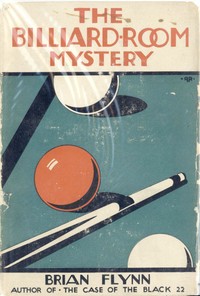
The Billiard Room Mystery — Edition Insights
19
6
Project Gutenberg
2018
Detective and mystery stories; England -- Social life and customs -- 20th century -- Fiction; Bathurst, Anthony (Fictitious character) -- Fiction
Readers of public-domain and historical texts
Project Gutenberg digital edition
en
Edition facts
Words: 63,573
Reading time: 277 min
Text sections: 10
Source:
Project Gutenberg record #58413
In this 1929 mystery, Anthony Bathurst investigates a country-house murder where the victim is found strangled and stabbed on a billiard table. The narrative, framed as a retrospective account, emphasizes police procedure and the puzzle of dual weapons, with excerpts focusing on Inspector Baddeley's methodical approach and the case's baffling details.
The Billiard Room Mystery opens not with a corpse but with a narrator who, after an eight-year gap, feels compelled to set down the "real facts" of a celebrated case. This framing device immediately signals that the story will be filtered through memory and selective disclosure. The narrator, a witness to the events, insists the affair ranks among "the most baffling in the annals of criminology," yet the excerpts reveal a story more concerned with procedural detail than sensationalism. Inspector Baddeley, not the amateur sleuth Anthony Bathurst, dominates the early chapters, methodically ticking off motives and puzzling over the victim's brown shoes with evening dress. The catalog subjects list "Detective and mystery stories" and "England -- Social life and customs -- 20th century," but the excerpts show a tighter focus: the mechanics of investigation, the banter of constables, and the physical evidence of a Venetian dagger and a shoelace.
A Narrator Who Withholds
The first chapter establishes a curious narrative stance. The narrator, who observed Bathurst at a private theatrical performance, claims to have had no opportunity for conversation, yet proceeds to describe Bathurst's "uncanny gifts for deduction, inference, and intuition" in detail. This retrospective framing creates a gap between what the narrator knows and what he chooses to reveal. He admits the account is written "for the first time" and that it can "harm nobody and prejudice no interests," implying that earlier silence was strategic. The excerpts do not disclose the narrator's identity or his exact role in the case, leaving the reader to wonder how much he is shaping the story. This device is more than a convention; it introduces an element of unreliability that the catalog's simple "Detective and mystery stories" label does not capture.
Police Work Over Puzzle-Solving
Despite the series featuring Anthony Bathurst as a recurring detective, the excerpts devote substantial space to Inspector Baddeley and his assistant Roper. Baddeley is described as "a man who took very few chances," and his method involves ticking off suspects and motives on his fingers, comparing fingerprints, and studying photographs of the dagger. The dialogue between Roper and Constable Griffiths reveals a police force that is methodical, gossipy, and aware of the case's peculiarities—"a bloke strangled and stabbed like this one was—like the pictures." The catalog subject "England -- Social life and customs -- 20th century" finds expression in the casual banter about Bank Holidays and Lewes Jail, but the excerpts suggest the novel's interest lies less in social panorama than in the granular details of evidence collection. Bathurst himself appears only in the narrator's admiring description; his actual investigative work is absent from these pages.
The Body and Its Oddities
The victim, Prescott, is found in the billiard room on the billiard table, dressed in evening wear but with brown shoes—a detail Baddeley finds significant. Two weapons were used: a shoelace that caused death and a Venetian dagger that was "not needed." The medical testimony confirms the shoelace was effective, yet the dagger's presence suggests either a second assailant or a staged scene. Baddeley's list of three suspects—Webb, Lieutenant Barker, and an unnamed third—hints at financial motives and interrupted activities, but the excerpts do not reveal the full constellation of characters. The catalog includes "Bathurst, Anthony (Fictitious character) -- Fiction," but the excerpts show Bathurst as a distant figure, praised for his memory and athleticism, while the actual detection is handled by the police. This tension between the series hero and the procedural focus is a notable feature of the opening chapters.
Setting as Clue and Atmosphere
The billiard room itself is more than a location; it is a clue. The body on the table, the Venetian dagger, the brown shoes—all are tied to this specific space. The excerpts do not describe the room's decor, but the title and the repeated references to the billiard table make it central. The narrator's mention of "private theatrical performance" and Bathurst's role as an amateur actor adds a layer of performance to the investigation. The catalog subject "England -- Social life and customs -- 20th century" is evoked through the country-house setting, but the excerpts focus on the room's functional role in the mystery. The reader is left to infer how the billiard room's layout, access, and typical use might have facilitated or complicated the crime.
Readers approaching The Billiard Room Mystery should note that the excerpts represent only the opening chapters, where the police investigation takes precedence over the amateur detective. The narrative frame—a retrospective account by an unnamed witness—may color the entire story. Pay attention to what the narrator chooses to emphasize and what he omits, as well as the physical details of the crime scene, which may hold more significance than first appears. The dual weapons and the victim's incongruous footwear are likely to be key.
Reader reflection
How did this book work for you?
Your answers remain private and are stored only in this browser.
Your progress
0
/
10
2
Was reading this book enjoyable?
3
Would you recommend this book to another reader?
4
How easy was the book to follow?
5
Was the book what you thought it would be?
6
How understandable was the text?
7
Did anything about the book feel genuinely new?
8
How strong was your personal connection to the text?
9
What is the main idea you are taking away?
10