1

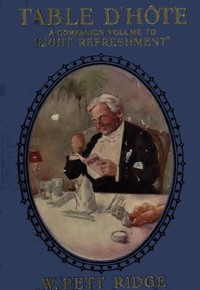
Table d'Hôte — Text and Context
12
2
Project Gutenberg
2018
Short stories, English; England -- Social life and customs -- 20th century -- Fiction; English fiction -- 20th century
Readers of public-domain and historical texts
Project Gutenberg digital edition
en
Edition facts
Words: 47,033
Reading time: 205 min
Text sections: 6
Source:
Project Gutenberg record #57349
W. Pett Ridge's 1911 collection of short stories uses clipped dialogue and precise domestic detail to expose power struggles in Edwardian London homes and streets, where fines, hiding under tables, and public embarrassment become weapons in everyday battles.
Editorial Edition Score
4.7/5
★★★★★
★★★★★
Calculated from edition completeness, EPUB availability, text structure and catalogue metadata. Not a user rating.
Edition quality
In 'Change of Government,' a husband threatens to dock his wife's allowance for not taking off his boots, then drafts a fine list: one shilling for not answering, one-and-six for unsatisfactory cooking, fourpence per excess relation. The wife's calm replies—'How would it be to fetch it for yourself?'—and her eventual triumph (hiding their son under the table) show how Ridge turns domestic negotiation into a comic war of wills. Throughout Table d'Hôte, such clipped exchanges and physical comedy recur, often turning on a single gesture or misheard word.
Diction as Weapon
Ridge's characters speak in short, rhythmic volleys. Mr. Baynes announces fines with bureaucratic precision—'For not answering when called, one shilling'—while his wife parries with deadpan literalism: 'Many as you like' (about the letter 't'). The author rarely uses tags beyond 'said' or 'remarked,' letting the dialogue's pace carry the tension. In 'Retiring Inspector,' a father's submissive 'None for me, mother' contrasts with his wife's brisk 'Speak up! I can't hear when you turn your face to the wall.' These verbal jabs reveal who holds power in each scene, often subverting the apparent authority of husbands or officials.
Domestic Geography
Ridge anchors his stories in specific, cramped interiors: a kitchen with a 'horsehair easy-chair,' an office basement with an 'iron grating' at the window, a front door with an 'elaborate knocker.' These settings are not mere backdrops but active participants. In 'Change of Government,' the husband's demand to 'stick up' the fine list on the wall turns the home into a workplace noticeboard. The boy hides under the table—a spatial trick that reverses the father's authority. Later, a character 'stepped out of the omnibus at Chancery Lane' with 'wisps of straw' on his boots, the detail marking his journey from suburban respectability to urban anxiety.
The Comedy of Misrecognition
Several stories hinge on mistaken identity or failed recognition. In 'Retiring Inspector,' a father seizes a schoolboy in a mortar-board, pinching his ear before apologizing—a moment of comic misdirection that echoes the larger theme of people failing to see each other clearly. The father later admits he feared his son might be embarrassed by a public kiss: 'Thought perhaps you might kiss me, father. And Watherston standing by.' Ridge uses these small social embarrassments to expose the gap between public roles and private feelings, often resolving the tension with a wry twist rather than sentiment.
Narrative Economy
Ridge's stories move swiftly, often covering hours or days in a few pages. He favors scene over summary, letting dialogue and action carry the plot. In 'Change of Government,' the entire marital conflict unfolds in a single kitchen scene, from the husband's first roar to the wife's triumphant reveal of the hidden boy. The author trusts readers to infer backstory from a few details—the 'memorandum-book and a short piece of pencil' that Mr. Baynes fishes from his pocket, or the 'home-made cake, still warm from the oven' that signals domestic competence. This economy extends to character names: 'Mr. Baynes' and 'Mr. Chelsfield' are distinguished by their titles alone, their first names never given.
Ridge's stories reward attention to what is left unsaid—the pause before a reply, the gesture that contradicts a word. Readers may find that the humor sharpens on a second reading, when the precise weight of a phrase like 'I see' or 'Don't talk with your mouth full!' becomes clear. These are not tales of grand events but of small, telling moments, and their pleasure lies in the craft of their telling.
Reader reflection
Record your reading impressions
A brief reflection can help important ideas stay with you longer.
Your progress
0
/
10
2
What was your overall reaction to the book?
3
How likely are you to recommend this book?
4
How easy was the book to follow?
5
What was the strongest part of the book?
6
How valuable was this book for your own interests?
7
What did you think about the pace?
8
How personally connected did you feel to the book?
9
Which lesson or insight stayed with you?
10