1

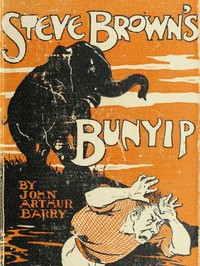
Steve Brown's Bunyip, and Other Stories — Reading Companion
23
3
Project Gutenberg
2019
Short stories; Sea stories; Australia -- Fiction
Readers of public-domain and historical texts
Project Gutenberg digital edition
en
Edition facts
Words: 79,336
Reading time: 345 min
Text sections: 9
Source:
Project Gutenberg record #60482
A collection of Australian outback and sea stories by John Arthur Barry, with introductory verses by Rudyard Kipling. The title story features a comical encounter with a mythical bunyip, while other tales depict survival, bush life, and maritime adventure, often with a wry narrative voice.
Editorial Edition Score
4.7/5
★★★★★
★★★★★
Calculated from edition completeness, EPUB availability, text structure and catalogue metadata. Not a user rating.
Edition quality
John Arthur Barry’s Steve Brown’s Bunyip, and Other Stories opens with a frontispiece illustration of a terrified man pleading, “Oh! Good Mister Bunyip,” capturing the blend of humor and peril that runs through the collection. The book’s contents list reveals a mix of inland and maritime settings—from “Dead Man’s Camp” and “Far Inland Football” to “A Cape Horn Christmas”—suggesting Barry’s range as a writer of both bush and sea yarns. The author’s preface frames the volume as an old ship refitted for new voyages, a metaphor that hints at the stories’ reissue after years out of print.
Kipling’s Contribution and the Author’s Voice
Rudyard Kipling contributed introductory verses that set a somber tone, speaking of a “Wife by the Northern March” who sends men to sea, where “some they drown in deep water, / And some in sight of shore.” This elegiac note contrasts with Barry’s own narrative style, which in the excerpt from “Far Inland Football” is colloquial and immediate: “Being in a hurry, I hadn’t time to pull myself up, so tumbled headlong into the water.” The first-person narrator describes a siege by Indigenous Australians with a matter-of-factness that reflects the attitudes of the period, using terms like “niggers” and “new chum.” Barry’s prose is brisk and sensory, focusing on physical details—the heat, the rock “blistering my skin,” the “shining stone like a lump of crystal” worn by the chiefs.
Survival and Spectacle in the Bush
The extended excerpt from “Far Inland Football” presents a survival scenario where the narrator, trapped on a rock, observes a group of Indigenous Australians performing a pantomime that he interprets as a threat to his homestead. The scene is structured as a series of discrete actions: the narrator rolls a stone onto an attacker, the group dances and points, and the narrator reads their gestures as a promise of violence. Barry’s description of the heat and the narrator’s improvised head-covering (“ripping out the lining of my coat”) grounds the drama in tangible discomfort. The story’s title, “Far Inland Football,” is ironic—the “football” is a stone used as a weapon, and the game is one of life and death. This tale, like others in the collection, blends adventure with a colonial perspective that modern readers will recognize as historically situated.
Structure and Thematic Range
The table of contents lists twenty stories, including “The Shanghai-ing of Peter Barlow,” “The Protection of the ‘Sparrowhawk,’” and “Books at Barracaboo,” indicating a variety of subjects from maritime coercion to outback literacy. The author’s preface describes the book as having been “long out of print” and now “rejuvenated and embellished,” suggesting that Barry saw these stories as durable artifacts. The collection’s catalog subjects—short stories, sea stories, Australia—are accurate but incomplete: the excerpts show that inland tales like “Far Inland Football” and “Dead Man’s Camp” are equally prominent. The presence of Kipling’s verses adds a literary cachet, but Barry’s own voice is the dominant one, direct and unadorned, suited to the yarn-spinning tradition.
Readers approaching this collection should expect a mix of humor and harshness, with stories that often pivot on a single, vivid incident. Barry’s characters are typically laconic and resourceful, and his settings—whether a ship’s cabin or a sun-baked rock—are rendered with precise, unromantic detail. The book offers a window into late-colonial Australian writing, where adventure and everyday life intersect, and where the bunyip of the title is only one of many strange encounters.
Reader reflection
Your personal reading reflection
Build a private reading journal entry for this title.
Your progress
0
/
10
2
How did the book work for you overall?
3
Would you recommend this book to another reader?
4
Did the language feel accessible?
5
How would you rate its originality?
6
Would you like to discuss this book with someone?
7
What was its emotional impact?
8
Which aspect of the book did you value most?
9
In one sentence, what did you learn?
10