1

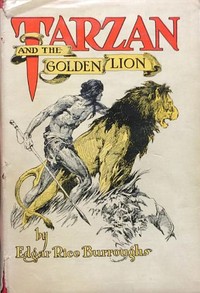
Tarzan and the Golden Lion — Context and Discussion
25
5
Project Gutenberg
2019
Tarzan (Fictitious character) -- Fiction; Fantasy fiction; Adventure stories
Readers of public-domain and historical texts
Project Gutenberg digital edition
en
Edition facts
Words: 85,105
Reading time: 371 min
Text sections: 9
Source:
Project Gutenberg record #58874
This editorial note examines how the opening focus on Sabor the lioness, the middle section's impostor plot, and later tower scenes shape a first reading of Burroughs's adventure, without assuming knowledge of the full novel.
Editorial Edition Score
4.8/5
★★★★★
★★★★★
Calculated from edition completeness, EPUB availability, text structure and catalogue metadata. Not a user rating.
Edition quality
The novel begins not with Tarzan but with Sabor, a lioness nursing her sole surviving cub after two daughters died from cold and undernourishment. This extended animal viewpoint—tracking her alertness, her memory of Wappi and Pacco, and her reaction to a faint sound—establishes a jungle where survival is precarious and sensory detail drives tension. The cub, Jad-bal-ja, will become the Golden Lion of the title, but the opening gives no hint of his later bond with Tarzan. Instead, readers encounter a naturalistic predator-prey world before any human character appears.
The Lioness as Lens
The first chapter devotes several paragraphs to Sabor’s perspective, a choice that orients the reader toward animal consciousness rather than human heroics. Burroughs describes her mourning—pacing, whining, nosing her dead cubs—and her hunger for Pacco, the zebra, whose flesh was the best beloved of her kind. This specificity of prey names (Wappi, Pacco) and the detailed account of cub mortality ground the story in ecological realism. The prose is tactile: a single fuzzy ball, spotted like Sheeta, the leopard. For a first-time reader, this opening signals that the jungle itself, with its cycles of birth and death, will be a central character.
The Impostor’s Strain
In the middle excerpt, Esteban Miranda impersonates Tarzan before the Waziri, and the strain shows. The Waziri cannot believe their Tarzan would flee from a charging rhinoceros; Usula’s remark—your faithful Waziri thought that it was the heart of their master that knew no fear—carries both sorrow and contempt. The impostor’s physical clumsiness (tripping, failing to climb a tree) contrasts sharply with Tarzan’s usual agility. This section reveals how Burroughs uses deception to test the loyalty and perception of the Waziri, and to highlight the gap between reputation and reality. Readers familiar with Tarzan’s prowess will feel the tension of a false identity that cannot hold.
Tower of Silence and Sound
The later excerpt shifts to a mysterious tower with a ring of doors, dim cressets, and a dome-like roof. Tarzan’s stealth is broken by a creaking hinge, and he senses movement behind him. The setting is claustrophobic and vertical, with multiple landings and a stairway protruding into darkness. Burroughs emphasizes sound: the creak, the faintest shadow of a sound, the silence before confrontation. This scene, from Chapter XII, introduces a built environment that feels alien after the open jungle. For a reader progressing through the novel, the tower represents a shift from animal tracking to architectural mystery, and the appearance of a figure in a doorway raises questions about who inhabits this place and what they want.
Tracking the Golden Lion’s Role
Despite the title, the golden lion Jad-bal-ja appears only briefly in the excerpts: the cub in Chapter I and the illustration caption Standing above him was Jad-bal-ja, the Golden Lion. The reader must infer how the cub grows into a companion. The table of contents lists chapters like “The Training of Jad-bal-ja” and “The Spoor of Revenge,” suggesting a developing partnership. However, the excerpts do not show Tarzan and the lion together. This gap invites the reader to watch for moments when animal and human paths cross. The early focus on Sabor’s maternal care may foreshadow a bond based on nurture rather than domination, but the text so far leaves that open.
These excerpts reward attention to sensory detail—smells, sounds, textures—and to the way Burroughs shifts perspective between animal, impostor, and hero. A first-time reader might track how the jungle’s physical laws (hunger, fear, territory) carry over into human conflicts. The tower sequence, with its locked doors and dim light, suggests that later chapters will combine exploration with puzzle-solving. No single excerpt resolves the plot, but together they map a world where identity is fragile and the environment is never neutral.
Reader reflection
How will you remember this book?
Save your reaction, strongest insight, and memorable passage.
Your progress
0
/
10
2
What was your overall reaction to the book?
3
Would you pass this book on to a friend?
4
What was the reading difficulty like?
5
How personally connected did you feel to the book?
6
How useful were the ideas in this book?
7
How did the reading compare with what you expected?
8
How did the pace of the book feel?
9
Which lesson or insight stayed with you?
10