1

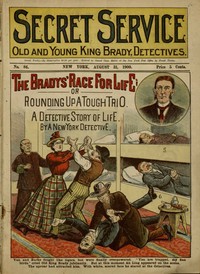
The Bradys' Race for Life; or, Rounding Up a Tough Trio: A Detective Story of Life — Reading Companion
22
4
Project Gutenberg
2019
Mystery and detective stories; Dime novels; American fiction
Readers of public-domain and historical texts
Project Gutenberg digital edition
en
Edition facts
Words: 30,924
Reading time: 135 min
Text sections: 5
Source:
Project Gutenberg record #60903
Francis Worcester Doughty's 1900 dime novel follows detectives Old and Young King Brady as they pursue a tough trio through New York City. The narrative shifts from a blood-soaked crime scene to a tense asylum rescue, revealing a plot involving a false murder accusation and a hidden heiress.
Editorial Edition Score
4.6/5
★★★★★
★★★★★
Calculated from edition completeness, EPUB availability, text structure and catalogue metadata. Not a user rating.
Edition quality
The story opens with a blood-curdling cry for help on a storm-swept New York street, drawing two citizens to a dingy tenement area where snow is saturated with blood. The absence of a body and the locked door set a grim scene. Doughty's prose relies on short, declarative sentences and exclamations like "Murder beyond a doubt!" to build urgency. The narrative quickly introduces the Bradys, who operate in a world where clues are physical—blood trails, locked doors, and a hurried police response. This opening establishes a pattern of rapid scene-setting and immediate action, characteristic of the dime novel format.
Voice and Dialogue as Characterization
Doughty distinguishes his detectives through speech patterns. Old King Brady speaks in measured, authoritative tones: "We are friends" and "Come a little nearer, young lady." His dialogue often includes explanatory asides, such as "That is the story of your mysterious disappearance as given to the world by your uncle." In contrast, the villains and bystanders use more colloquial, breathless language. The young woman Evelyn Grimm speaks with emotional intensity: "Oh, I am thankful!" and "I shall die if I remain longer." This vocal contrast reinforces the moral clarity of the story, where good and evil are signaled by tone as much as by action.
Pacing Through Physical Description
The narrative accelerates through brief, vivid descriptions of settings and actions. The opening area is "illy lighted by a gaslight" and "dingy." Later, the asylum cell is described with minimal detail, focusing instead on the characters' reactions: "A frightened light was in her eyes." Doughty often uses a single sentence to shift location or time, as when the hurry wagon "arrived with more officers." This technique keeps the plot moving at a breathless pace, typical of serialized detective fiction. The reader is propelled from the crime scene to the cell without dwelling on exposition.
Recurring Motifs of Entrapment and Rescue
Two key scenes mirror each other: the locked tenement door and the barred asylum cell. In both, characters are trapped and must be freed by outside intervention. The police force the tenement door; Old King Brady draws close to the cell bars. The motif extends to the plot itself: Evelyn Grimm is confined against her will, and the Bradys work to "round up" the tough trio. Doughty reinforces this through repeated words like "trapped" and "rescue." The pattern suggests a world where justice requires physical breach of barriers, whether doors or false accusations.
Readers should attend to how Doughty balances rapid action with moments of stillness, such as the cell conversation where Evelyn tells her story. The dime novel format rewards attention to small details—a name repeated with a gasp, a locked door, a blood trail—that build toward the revelation of the plot. The Bradys' method is cumulative, not deductive, and the pleasure lies in watching them piece together clues from overheard words and observed scenes.
Reader reflection
What did you think of this book?
Answer a few questions and save a private reflection on this device.
Your progress
0
/
10
2
How did the book work for you overall?
3
How likely are you to recommend this book?
4
What was the reading difficulty like?
5
Could you see yourself revisiting this book?
6
Did the book meet your expectations?
7
What was its emotional impact?
8
Did anything about the book feel genuinely new?
9
What did this book teach you most?
10