1

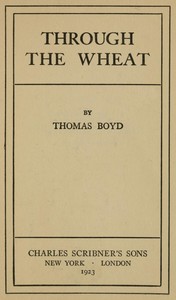
Through the Wheat — Story, Setting & Ideas
24
3
Project Gutenberg
2019
World War, 1914-1918 -- Fiction; War stories; United States. Marine Corps -- Fiction
Readers of public-domain and historical texts
Project Gutenberg digital edition
en
Edition facts
Words: 54,761
Reading time: 239 min
Text sections: 6
Source:
Project Gutenberg record #58796
Thomas Boyd's 1923 novel follows Marine William Hicks through the disillusionment of World War I, using sharp dialogue, sensory detail, and a restrained third-person voice to render the gap between patriotic expectation and the absurdity of combat.
Editorial Edition Score
4.7/5
★★★★★
★★★★★
Calculated from edition completeness, EPUB availability, text structure and catalogue metadata. Not a user rating.
Edition quality
Thomas Boyd opens Through the Wheat with a simile that sets the tone: dusk falls “like soft blue smoke” on a French village, and the buildings appear “like false teeth in an ash-old face.” The image is deliberately ugly and precise, signaling a narrator who will not romanticize the setting. The protagonist, William Hicks, is introduced leaning against a canteen wall, his body an “unseemly blot” on the white surface. Boyd immediately establishes Hicks’s frustration: he enlisted to fight, but has spent nine months as a military policeman and stevedore. The gap between expectation and reality—the recruiting sergeant’s promise of “real action” versus digging holes—is the novel’s driving tension.
Diction and the Soldier’s Voice
Boyd’s diction shifts between Hicks’s interior monologue and the narrator’s more detached observations. When Hicks thinks, the language is colloquial and bitter: “A hell of a way to treat a white man.” The phrase is period-specific and reveals a casual racism that Boyd does not comment on, letting the character’s voice stand. In contrast, the narrator describes the cans Hicks bought as “prisoning the white wine” and the clerk as “wizened,” choosing verbs that imply entrapment and age. The effect is a layered perspective: the reader sees both what Hicks feels and what the scene objectively contains.
The Letter as a Device of Contrast
The letter from Ellen, written in lavender ink with a stamp angled to mean “I love you,” is a set piece of clashing registers. Her voice is full of capitalized words (“BRAVE,” “AWFUL,” “ESPECIALLY”) and sentimental clichés about “horrid trenches” and “Huns.” Boyd reproduces the letter verbatim, letting its naïve tone contrast sharply with the preceding scenes of exhaustion. Hicks’s reaction—crushing the letter, then smoothing it out—is rendered in physical terms: “Hope was burned to a white crisp.” The letter does not advance plot but exposes the emotional distance between home-front rhetoric and the soldier’s reality.
Structure and the Accumulation of Detail
Boyd builds scenes through accumulation rather than dramatic incident. In the opening, Hicks’s frustration is conveyed by a list of his labors: “shunted from one place to another, acting out the odious office of the military police, working as a stevedore beside evil-odored blacks, helping to build cantonments and reservoirs.” The syntax is paratactic, piling grievances without subordination. Later, the description of the cans and bottles—their number, their labels, the clerk’s suspicion—creates a microcosm of the soldier’s daily uncertainty. Boyd trusts that concrete details will carry meaning without authorial commentary.
Voice and the Limits of Knowledge
The third-person narration stays close to Hicks but occasionally pulls back, as when the messenger hands over mail: “Harriman fairly grabbed at the package of letters, so eager he was to see if it contained one for him.” The adverb “fairly” suggests a narrator who observes from slightly outside. Boyd does not explain why Harriman’s letter is different—the angled stamp, the lavender paper—but lets the reader infer. This restraint is consistent: the novel presents what is visible and audible, leaving interior states to be deduced from action. The excerpts offer no omniscient judgments, only the raw data of behavior and speech.
Readers who attend to Boyd’s choices in diction, dialogue, and descriptive detail will find a war novel that earns its effects through understatement. The prose does not explain; it shows. The result is a work that feels both immediate and historically specific, grounded in the small frustrations and fleeting comforts of a marine’s daily life. The excerpts suggest a narrative that values precision over sentiment, and that may reward careful attention to its quiet, cumulative power.
Reader reflection
How will you remember this book?
Save your reaction, strongest insight, and memorable passage.
Your progress
0
/
10
2
Did this book hold your interest?
3
How likely are you to recommend this book?
4
How easy was the book to follow?
5
Did the book offer a fresh perspective?
6
Did the book give you something worth debating?
7
How would you describe its reading pace?
8
Would you read this book again?
9
In one sentence, what did you learn?
10