1

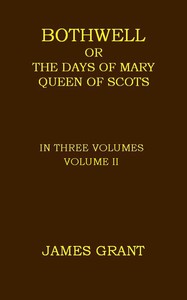
Bothwell; or, The Days of Mary Queen of Scots, Volume 2 (of 3) — Context and Discussion
21
4
Project Gutenberg
2017
Mary, Queen of Scots, 1542-1587 -- Fiction; Bothwell, James Hepburn, Earl of, 1536?-1578 -- Fiction; Scotland -- History -- Mary Stuart, 1542-1567 -- Fiction
Readers of public-domain and historical texts
Project Gutenberg digital edition
en
Edition facts
Words: 58,838
Reading time: 256 min
Text sections: 9
Source:
Project Gutenberg record #55528
James Grant's second volume of 'Bothwell' shifts between courtly intrigue and violent street brawls, using rapid dialogue and vivid costume detail to contrast Mary's French-speaking grace with Bothwell's reckless swagger.
The second volume of James Grant's historical novel opens with Bothwell entering the Queen's presence in full armour, his attire described with a tailor's precision: a coat-of-mail so flexible it 'incommoded him less than the velvet doublet below it,' black velvet trunks slashed with red, and a blue velvet bonnet bearing a silver horse's-head crest. Mary addresses him in French—'Prenez garde, monseigneur!'—and the exchange is light, almost flirtatious, until the narrator notes that Moray and Morton exchange 'another of their deep glances.' The scene establishes a court where every word is watched.
Costume as Character
Grant lingers on clothing not as mere decoration but as a marker of allegiance, mood, and threat. Bothwell's 'rich attire gleamed in the full flush of the noonday sun' when he enters the throne room; later, in the street, he wears a 'pyne doublet that would turn the bolt of an arblast.' The contrast between courtly finery and practical armour mirrors the novel's own oscillation between formal dialogue and sudden violence. When the Marquis d'Elboeuff proposes breaking into a house, the shift from silk to steel is immediate: 'Draw, chevaliers!—vive la joie!' The prose itself becomes more staccato, less courtly, as the scene descends into a drunken brawl.
The Rhythm of Insult and Retort
Grant's dialogue moves in quick, combative exchanges that reveal character through rhythm. Bothwell's speech is peppered with oaths and abrupt commands—'Peace, gomeral!'—while the French Marquis uses elaborate curses: 'Nom d'un Pape!' and 'Tete Dieu!' The Earl of Coldinghame stammers, 'Speak not of sleep,' and is overridden. The pace accelerates when the group considers attacking John Knox's house: the Marquis falls back 'abashed on hearing that formidable name,' and the tone shifts from swagger to caution in a single line. These changes in tempo—from leisurely courtly banter to rapid, threatening repartee—give the narrative a volatile, unpredictable energy.
Setting as a Stage for Tension
The physical spaces in these excerpts are charged with social meaning. The Queen's chamber is described with 'mullioned casement' and 'arras,' a controlled environment where every gesture is observed. In contrast, the Edinburgh wynd is 'misty,' with windows 'partly open' emitting 'the odour of a close room and a luxurious supper.' The street becomes a theatre for male aggression, where Bothwell boasts of showing 'these rascally bailies that their night-watch had no reference to us.' Grant uses setting to modulate pace: the closed court slows dialogue to measured courtesy; the open street accelerates it into threats and laughter. The threshold between these worlds—the moment Bothwell 'stooped and entered' the Queen's chamber—marks a shift in register that the novel repeats throughout.
Readers attentive to Grant's handling of voice will notice how he uses French phrases, Scots dialect ('gomeral,' 'ettle'), and English oaths to stratify his characters socially and temperamentally. The narrative rarely pauses for reflection; it moves by action and retort. Treat the volume as a sequence of charged encounters rather than a continuous plot, and watch for the moments when the prose itself changes speed—those are the hinges on which the drama turns.
Reader reflection
Your personal reading reflection
Build a private reading journal entry for this title.
Your progress
0
/
10
2
Was reading this book enjoyable?
3
Would you pass this book on to a friend?
4
How much effort did this book require?
5
Did it raise ideas you would like to talk about?
6
Did the story or argument move comfortably?
7
What did you appreciate most?
8
Did any part of the book stay with you emotionally?
9
What is the main idea you are taking away?
10