1

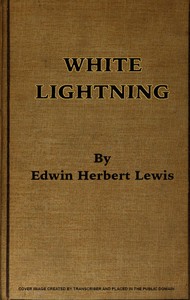
White Lightning — Text and Context
15
3
Project Gutenberg
2019
Love stories; Bildungsromans; Scientists -- Fiction; United States -- Fiction
Readers of public-domain and historical texts
Project Gutenberg digital edition
en
Edition facts
Words: 83,880
Reading time: 365 min
Text sections: 93
Source:
Project Gutenberg record #58594
In Edwin Herbert Lewis's 1923 novel, a boy's curiosity about water burning leads into a story spanning Chicago, the Great Lakes, and Ojibwe territory, blending scientific inquiry with reflections on land, history, and cultural change.
Editorial Edition Score
4.9/5
★★★★★
★★★★★
Calculated from edition completeness, EPUB availability, text structure and catalogue metadata. Not a user rating.
Edition quality
The novel opens with twelve-year-old Marvin Mahan watching a blacksmith sprinkle water on a fire, concluding that "water will burn." This moment of scientific curiosity, set in a Chicago smithy in 1905, establishes a pattern: the boy's observations lead him to his father's laboratory, where a phosphor-bronze sieve and sunlight produce a spectrum. The father, a mining engineer, acknowledges the discovery as a new way to measure light-waves. Yet the narrative quickly moves beyond the laboratory, introducing Ojibwe characters and a canoe journey downriver. The catalog subjects list "Scientists -- Fiction" and "Love stories," but the excerpts show a novel equally concerned with Indigenous perspectives, land dispossession, and the ethics of progress.
A Scientist Who Listens
Marvin Mahan is cataloged as a scientist, but the excerpts show him learning as much from Indigenous knowledge as from laboratory equipment. When a boy named Shinguakonse addresses him as "the Bear" and expects his help, Marvin does not correct him but reflects on the situation. The narrative notes that "the boy had even seemed to be expecting him"—a detail that suggests a connection Marvin himself does not fully understand. Later, Marvin considers buying an island full of dead chiefs, comparing it to requesting cemetery bones for calcium carbide. This dry humor undercuts any simple portrait of a rational scientist. The novel presents a protagonist who moves between worlds, observing both the chemistry of light and the politics of land.
Land, Memory, and the View from the Mountain
Chapter 41 shifts to Jean and her father surveying Bay-quah-de-nah-shing. The father recalls standing on the same mountain with surveyors, a historian, and Ojeeg, who "could stand for a long time in silence to survey his ancient homeland, but who would be sure at last to say something bitter about the trading posts where his ancestors were deliberately made drunkards." The passage weaves together multiple historical layers: the boundary dispute after the War of 1812, the sealing industry that slaughtered mothers for skins, and the Civil War. The father's reflection that "there was no more frontier left, and no more chance for the democracy which is possible when land is abundant" ties personal memory to national loss. The catalog subject "United States -- Fiction" is here grounded in specific, unsentimental detail.
Voice and the Unspoken
Lewis's prose shifts between registers: the boy's wonder, the father's wry asides, and the old man's elegiac tone. When Marvin thinks about ethyl alcohol as "the approved business means of eliminating backward races decently," the irony is sharp and unsettling. The novel does not soften its characters' views. Ojeeg's bitterness is reported but not dramatized; the father's regret over "forty youths whom he had slain" is stated without melodrama. The excerpts suggest a book that trusts readers to hold contradictions: the scientist who profits from mining, the land that is beautiful and stolen, the boy who is both curious and complicit. The love story hinted at in the catalog remains largely offstage in these passages, subordinated to a broader meditation on inheritance.
Readers should attend to the novel's structure: chapter titles like "Hydrogen" and "Columbium" hint at a periodic table of elements, but the narrative itself resists systematic order. The excerpts offer no clear plot arc—no romance consummated, no discovery patented, no resolution to the questions of land and legacy. This is a book that values the oblique: the glance, the memory, the half-spoken observation. Approach it as a series of linked meditations rather than a linear story, and let the silences between scenes carry as much weight as the dialogue.
Reader reflection
Your personal reading reflection
Build a private reading journal entry for this title.
Your progress
0
/
10
2
How did the book work for you overall?
3
How likely are you to recommend this book?
4
How easy was the book to follow?
5
How would you rate its originality?
6
How clearly were the main ideas presented?
7
How much did the book move you?
8
Did it raise ideas you would like to talk about?
9
In one sentence, what did you learn?
10