1

Merry Tales — Text and Context
22
4
Project Gutenberg
2019
United States -- History -- Civil War, 1861-1865 -- Fiction; Humorous stories, American; War stories, American
Readers of public-domain and historical texts
Project Gutenberg digital edition
en
Edition facts
Words: 41,382
Reading time: 180 min
Text sections: 12
Source:
Project Gutenberg record #60900
Mark Twain's 'Merry Tales' collects seven stories, including the Civil War memoir 'The Private History of a Campaign that Failed' and the spy thriller 'A Curious Experience,' showcasing his blend of humor, suspense, and sharp observation.
Editorial Edition Score
4.7/5
★★★★★
★★★★★
Calculated from edition completeness, EPUB availability, text structure and catalogue metadata. Not a user rating.
Edition quality
The opening story, 'The Private History of a Campaign that Failed,' immediately establishes a conversational, self-deprecating tone as Twain recounts his brief stint in the Confederate militia. He writes, 'You have heard from a great many people who did something in the war; is it not fair and right that you l...' The abrupt cutoff in the excerpt hints at his characteristic irony. The narrative voice is intimate, almost confiding, drawing the reader into a personal anecdote that promises both humor and historical reflection.
A Campaign of Self-Deprecation
The first story sets the volume's tone: Twain presents himself not as a hero but as a bewildered participant. The excerpt shows him describing the campaign's failure with a mix of embarrassment and wry humor. He emphasizes the absurdity of the situation—young men playing soldier without clear purpose. The phrase 'campaign that failed' is literal, but Twain's treatment suggests a deeper critique of romanticized war narratives. Readers should note how he undercuts any expectation of glory, focusing instead on confusion and anticlimax.
Spy Games and Suspense
'A Curious Experience' shifts to a different kind of tension: a suspected spy within a Union fort. The excerpt reveals a meticulous interrogation scene, where the commandant confronts a young recruit named Wicklow. Twain builds suspense through dialogue and detail—the 'sympathetic ink' letter, the cryptic note 'Eagle's Third Flight. Remember xxxx. 166.' The boy's 'childlike wonderment' and 'big soft eyes' contrast with his apparent deceit. This story showcases Twain's ability to craft psychological drama, moving beyond pure comedy into darker territory.
Voice and Verisimilitude
Across the excerpts, Twain's prose is marked by colloquial rhythms and precise observation. In the interrogation scene, the commandant's calm, methodical questioning ('Why do you go to that old stable so much?') creates a cat-and-mouse dynamic. Twain avoids melodrama, letting the tension emerge from small details—the boy's 'fumbling with a button,' the 'slight tinge' on his cheek. This restraint makes the eventual revelation more impactful. Readers should attend to how Twain uses understatement to heighten effect.
Structure and Selection
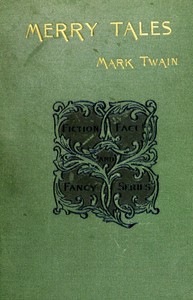
The table of contents lists seven stories, ranging from the Civil War memoir to tales like 'The Invalid's Story' and 'Mrs. McWilliams and the Lightning.' The editor's note explains the 'Fiction, Fact, and Fancy Series' aims to provide 'reading in a shape adapted to the amount of time at their disposal.' This suggests the collection was designed for quick, engaging reads. The variety—from war to domestic comedy—indicates Twain's range. Readers might consider how the order of stories creates a rhythm, alternating between longer narratives and shorter sketches.
As you read, note how Twain's humor often serves as a vehicle for sharper commentary. The Civil War story may seem lighthearted, but its title admits failure; the spy story builds to a revelation that questions appearances. The excerpts offer only fragments, but they reveal a writer who uses laughter to explore serious themes. Approach each tale on its own terms, and watch for the subtle shifts in tone that mark Twain's craft.
Reader reflection
What did you think of this book?
Answer a few questions and save a private reflection on this device.
Your progress
0
/
10
2
What was your overall reaction to the book?
3
Would you pass this book on to a friend?
4
How easy was the book to follow?
5
Do you expect to return to this book?
6
Did you relate to its people, ideas, or situations?
7
How original did the book feel?
8
Could you apply anything you learned?
9
Which lesson or insight stayed with you?
10