1

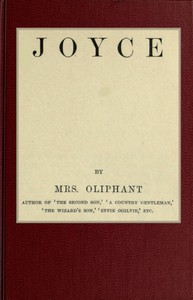
Joyce — Edition Insights
36
6
Project Gutenberg
2020
Young women -- Fiction; Adopted children -- Fiction; Great Britain -- Social life and customs -- 19th century -- Fiction; Social classes -- Fiction
Readers of public-domain and historical texts
Project Gutenberg digital edition
en
Edition facts
Words: 182,833
Reading time: 795 min
Text sections: 15
Source:
Project Gutenberg record #61378
Mrs. Oliphant's 1888 novel follows Joyce, a young woman navigating social class and family secrets in 19th-century Britain. The narrative moves between domestic interiors and public festivities, using recurring motifs of homecoming and ecclesiastical disputes.
Editorial Edition Score
4.8/5
★★★★★
★★★★★
Calculated from edition completeness, EPUB availability, text structure and catalogue metadata. Not a user rating.
Edition quality
The novel opens not with its heroine but with a homecoming that is deliberately off-kilter: a bearded, bronzed man nearing thirty returns to an estate where his own father and mother live as dependents. This inverted coming-of-age sets the structural pattern for the book, which repeatedly stages arrivals and departures that unsettle domestic hierarchies. The narrator’s wry observation that Norman Bellendean knows India intimately but is “as ignorant as a child” of London life establishes a voice alert to the comedy of provincial sophistication.
Recurring Thresholds
The story moves through a series of thresholds—doorways, garden gates, rectory parlours—where characters are caught between inside and outside. Joyce’s first encounter with the Canon takes place on a path between fields; later, the school-feast spills from the building into the open air. These liminal spaces mirror the characters’ social positions: Joyce is neither fully a daughter nor a stranger, Norman is both master and guest. The narrator lingers on the physical act of crossing into a room, as when the Canon’s “fine bass dropped into a lower key” the moment he steps inside and speaks of Joyce’s mother. Each threshold becomes a site where hidden knowledge—about parentage, inheritance, or past alliances—threatens to surface.
Voices in Dispute
Dialogue drives the novel’s conflicts, and the excerpts show a fondness for ecclesiastical sparring. The Canon’s speech is full of theatrical nicknames—“Soapy Sam,” “the Great Gun”—and he describes his opponents with a relish that turns theological disagreement into personal sport. Mrs. Sitwell, the parson’s wife, is reported to “make a little drama” of every slight, walking about the room to mimic her enemies. These verbal skirmishes are not merely background; they structure the plot, as when Joyce’s innocent remark about Miss Marsham’s regrets triggers the Canon’s laughter and a shift in his allegiance. The narrator rarely editorialises, letting the characters’ own words reveal their motives and blind spots.
The Weight of a Name
Names carry unusual force in this novel. Joyce’s own name is immediately linked to her mother’s: the Canon breaks off mid-sentence, “Joyce—why, to be sure, that was her mother’s——”, and the unfinished thought hangs in the air. The title itself, Joyce, is both a given name and a patronymic echo. Elsewhere, characters are reduced to labels—“that Scotch fellow” is enough to make Joyce turn “very red, and then very pale.” The narrator notes that Joyce struggles not to call the Canon “sir,” a word that would mark her as a schoolgirl rather than an equal. These small linguistic battles—what to call whom, and when—encode the larger struggle over identity and belonging that runs beneath the social comedy.
Festivity as Pressure Point
Public celebrations—the coming-of-age feast, the school-feast, the supper-party—are where the novel’s tensions peak. These gatherings force characters who would otherwise avoid each other into close quarters. The school-feast in Chapter XXV becomes a stage for Mrs. Sitwell’s “little drama” of indignation, while the earlier homecoming festivities expose the awkwardness of Norman’s position. The narrator treats these events with a mixture of affection and irony, noting the “great exultation” of one faction and the barely concealed resentment of another. Food, music, and speeches are never merely decorative; they are the medium through which alliances shift and old wounds reopen. The reader is invited to watch not the official programme but the glances, interruptions, and whispered asides that reveal the true action.
Because the excerpts cover only the opening and a middle chapter, the full arc of Joyce’s story remains unknown. What is clear is that Mrs. Oliphant builds her novel from small, precisely observed social encounters rather than large set-pieces. Readers who attend to the rhythm of entrances and exits, and to the way a single nickname can carry a character’s entire history, will find a work of quiet craft beneath its Victorian surface.
Reader reflection
Your personal reading reflection
Build a private reading journal entry for this title.
Your progress
0
/
10
2
Was reading this book enjoyable?
3
Is this a title you would suggest to others?
4
Did the language feel accessible?
5
How would you rate its originality?
6
Was the book moving at the right speed?
7
How much did the book move you?
8
How closely did the book connect with your experience?
9
Which lesson or insight stayed with you?
10