1

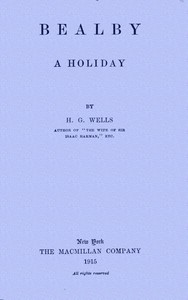
Bealby; A Holiday — A Reader’s Guide
12
2
Project Gutenberg
2019
Boys -- Fiction; Household employees -- Fiction; Country homes -- England -- Fiction
Readers of public-domain and historical texts
Project Gutenberg digital edition
en
Edition facts
Words: 74,748
Reading time: 325 min
Text sections: 76
Source:
Project Gutenberg record #59769
Wells's comic novel follows young Bealby's rebellion against becoming a steward's boy at Shonts, a grand country house, and the ensuing holiday chaos. The narrative contrasts Bealby's blunt defiance with the internal conflicts of Captain Douglas, torn between ambition and romance.
Editorial Edition Score
4.8/5
★★★★★
★★★★★
Calculated from edition completeness, EPUB availability, text structure and catalogue metadata. Not a user rating.
Edition quality
Wells opens Bealby; A Holiday with a mock-serious sociological observation: butlers and lady's maids do not reproduce their kind, so successors must be sought among the prolific on great estates. This deadpan voice immediately establishes the novel's satirical tone. The narrator then introduces Shonts—its facade, towers, marble pond, and peacocks—with a breathless catalogue that mimics estate-agent puffery, undercut by the aside that the Velasquez is now in America. The prose shifts abruptly to young Bealby's hot-faced declaration: "I'm not going to be a steward's boy at the house anyhow." The contrast between the grand setting and the boy's blunt refusal sets up the central conflict.
A Boy's Defiance in the Gardener's Kitchen
The first chapter establishes Bealby's rebellion through concrete, sensory details. He enters the kitchen with "his hair all ruffled and his face hot and distinctly dirty, and his hands in his trousers pockets." His mother is preparing a steak and kidney pie—a homely, specific image that grounds the scene. Bealby's speech is direct and unpolished: "not if you tell me to, not till you're blue in the face." Wells gives him a voice that is stubborn and colloquial, free of the deference expected of a servant's son. The narrator's earlier, almost anthropological commentary on the reproduction of servants contrasts sharply with Bealby's raw refusal, highlighting the gap between social theory and individual will.
The Divided Mind of Captain Douglas
Captain Douglas is introduced as a man of concealed resolve, hiding his ambition behind "an easy-going unpretending gentlemanliness." Wells uses a tripartite structure to dissect his psyche: the first strand is his desire to serve and accomplish great things; the second is his attraction to Madeleine Philips; the third is the conflict between them. The narrator notes that Madeleine "herself was a career," and that Douglas's love-letters replaced his "secret vice of thinking." This ironic phrasing suggests that thinking itself is a vice in his social world. Douglas's internal struggle is rendered through his absent-mindedness and "incompleted sentences," a verbal tic that reveals his turmoil beneath a composed exterior.
Madeleine's Ideal and the Reality of Love
Madeleine Philips is presented as a woman who has "made herself for love," moving through life "like its empress." Her ideal lover is described as "a oleographic copy of a Laszlo portrait of Douglas greatly magnified"—a deliberately kitschy image that deflates romantic pretension. She expects him to be a conqueror and administrator while attending exclusively to her. Wells exposes the absurdity of this demand through Douglas's growing realization that her love is a full-time occupation. The dialogue about flying—"I should love to soar through the air"—is undercut by the practical note that she travels with many trunks. The novel's comedy arises from the gap between her grandiose expectations and the mundane logistics of desire.
Narrative Voice and Social Satire
Wells's narrator adopts a tone of detached, ironic observation. The opening paragraph's mock-taxonomic classification of servants—gardeners, gamekeepers, coachmen, but not lodge people—parodies scientific discourse. The catalogue of Shonts's glories is delivered with a straight face, but the mention of the Laxtons, "the Peptonized Milk and Baby Soother people," reveals the estate's commercial decline. The narrator frequently generalizes about human nature: "only the natural perversity of human nature can explain the violent objection." This creates a knowing, slightly condescending voice that distances the reader from the characters while inviting amusement at their follies. The prose is brisk, with short paragraphs and sudden shifts in register.
Readers should attend to Wells's use of free indirect discourse, which slides between the narrator's sardonic commentary and the characters' unspoken thoughts. The novel's comedy depends on the tension between what characters say and what the narrator reveals about their inner lives. Bealby's story is only one strand; the holiday of the title encompasses multiple characters' escapes from social roles. The excerpts suggest a work that is less a straightforward adventure than a satirical anatomy of Edwardian class and romance.
Reader reflection
How did this book work for you?
Your answers remain private and are stored only in this browser.
Your progress
0
/
10
2
Did this book hold your interest?
3
Would you recommend this book to another reader?
4
Did the language feel accessible?
5
What was the strongest part of the book?
6
Could you apply anything you learned?
7
What was its emotional impact?
8
Did any part of the book feel personally relevant?
9
What changed or sharpened your thinking?
10