1

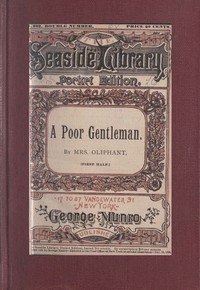
A Poor Gentleman — A Reader’s Guide
40
7
Project Gutenberg
2020
Inheritance and succession -- Fiction; Man-woman relationships -- Fiction; England -- Social life and customs -- Fiction; Families -- Fiction
Readers of public-domain and historical texts
Project Gutenberg digital edition
en
Edition facts
Words: 168,908
Reading time: 735 min
Text sections: 14
Source:
Project Gutenberg record #61782
Mrs. Oliphant's novel contrasts the grand but cheerless Penton estate with the lower-lying Penton Hook, focusing on inheritance tensions and a young heir's conflicted loyalties. The excerpts reveal a sharp ear for social mimicry and a narrative voice that undercuts romantic expectations.
Editorial Edition Score
4.8/5
★★★★★
★★★★★
Calculated from edition completeness, EPUB availability, text structure and catalogue metadata. Not a user rating.
Edition quality
The opening chapter of A Poor Gentleman devotes unusual attention to architecture: Penton's front is 'Grecian, or rather Palladian, in heavy stone supplemented by plaster,' while the garden-front is 'of the livelier French order.' This detailed description of the house sets up a contrast with Penton Hook, the lower-lying estate on the river. The narrator notes that Penton's gardens 'are such as Watteau would have delighted in,' yet immediately undercuts the picturesque by observing that the household consists of an old baronet, his married daughter 'between forty and fifty,' and her husband—'no more.' The cheerlessness of the great house is established before any plot begins.
Architecture as Social Metaphor
The novel opens with a lengthy description of Penton's façade, but the narrator's eye is not merely scenic. The front is 'heavy stone supplemented by plaster'—a detail that hints at pretension. The garden-front, though livelier, belongs to a French style that feels out of place in the English county. The water-works are 'a little out of order now,' and the statues are 'half covered with lichens.' These small flaws accumulate into a portrait of a house that is grand but decaying, much like the family within. The contrast with Penton Hook, 'on a lower level' and 'almost an island,' is spatial and social: the lower house is physically closer to the river, suggesting a different relationship to land and livelihood.
Voice and Social Mimicry
In the second excerpt, Walter Penton encounters a village girl who impersonates 'old Crockford’s niece' with perfect mimicry. She says, 'I knows my place and how to behave to my betters,' and drops a courtesy in the middle of the road. Walter is irritated—'Could not she see that he was in no humor for jest to-day?'—yet he admits 'the tone of her imitation was perfect.' This moment reveals a preoccupation with voice and class performance. The girl shifts from mock deference to a 'tenderest, coaxing tone' when she says 'Poor boy!' and touches his arm. The narrative tracks Walter's emotional response: 'a shock, a thrill of sweeter consciousness went through him.' Yet the girl's own mind is 'full of perplexed impatience'—she does not care about his family troubles. The gap between what Walter feels and what she feels is left unclosed.
Inheritance and the Unconsulted Heir
Walter's central grievance is that he was 'left out' of a bargain between his father and his cousin, and 'his consent never asked, though he was the heir.' He recounts being sent to fetch the parties and the papers, and being tempted to delay: 'If I had not answered from my room when I heard them, if I had pretended not to hear, if I had only held back, which would have been no sin!' The novel thus frames inheritance not as a static condition but as a process of negotiation and omission. Walter's self-pity is rendered with ironic distance—'that self-pity which is so warm at his age'—and the girl's divided attention undercuts the drama. The catalog subject 'Inheritance and succession' is present, but the excerpts show it entangled with questions of consent, timing, and the heir's own passivity.
Readers should attend to how Oliphant uses setting and voice to complicate the inheritance plot. The architectural details are not mere backdrop; they encode the social standing and emotional temperature of each house. The village girl's mimicry and Walter's self-absorption suggest that the novel is as interested in miscommunication as in property. The excerpts offer no resolution, only a series of contrasts—between high and low, grand and shabby, earnest and mocking—that the full text may sustain or subvert.
Reader reflection
How will you remember this book?
Save your reaction, strongest insight, and memorable passage.
Your progress
0
/
10
2
How did the book work for you overall?
3
How likely are you to recommend this book?
4
How easy was the book to follow?
5
Do you expect to return to this book?
6
Did any part of the book feel personally relevant?
7
How much did the book move you?
8
How original did the book feel?
9
What is the main idea you are taking away?
10