1

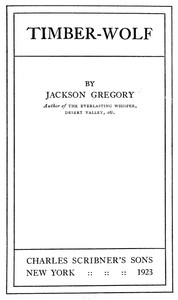
Timber-Wolf — Context and Discussion
49
5
Project Gutenberg
2020
Western stories; Gold mines and mining -- Fiction; American fiction -- 20th century
Readers of public-domain and historical texts
Project Gutenberg digital edition
en
Edition facts
Words: 103,440
Reading time: 450 min
Text sections: 10
Source:
Project Gutenberg record #61329
Jackson Gregory's 1923 western novel opens with a dog fight sparking a riot in Big Pine, then shifts to a tense wilderness captivity where a woman is chained like a wolf-hound. The prose contrasts boisterous frontier humor with psychological cruelty, using steel chains and loaded silences as narrative devices.
Editorial Edition Score
4.8/5
★★★★★
★★★★★
Calculated from edition completeness, EPUB availability, text structure and catalogue metadata. Not a user rating.
Edition quality
Jackson Gregory’s Timber-Wolf opens not with a lone rider on the skyline but with a dog fight that escalates into a town-wide riot, complete with sawed-off shotguns and citizens digging in “as for a state of siege.” The narrator’s wry tone—noting that the old-timers recalled the 1882 affair with fine esprit—establishes Big Pine as a place where excitement, once stirred, skyrockets into the seventh heaven of turbulence. Yet the real catalyst is not the brawl itself but what spills from a torn coat pocket: a discovery that transmutes “slumbrous quiet into pandemonium.”
The excerpts then shift abruptly from communal uproar to a private, claustrophobic captivity. A woman is chained about the waist with a steel padlock, the leash originally meant for a wolf-hound. Gregory’s prose here is lean and physical—the click of the lock, the stamping out of coals, the big hat carrying creek water—and the dialogue crackles with mockery and defiance. The contrast between the town’s boisterous chaos and the isolated, psychological cruelty of the wilderness encounter forms the novel’s central tension.
The Chain as a Narrative Device
The steel chain that Bruce Standing snaps around the woman’s waist is more than a prop; it is a concentrated emblem of power and degradation. Gregory describes it as “a thin steel chain, a chain which he had brought with him from his ranch headquarters, where it had served as leash for a wolf-hound.” The padlock clicks “scarcely bigger than a silver half-dollar,” and Standing calls it “the sign of your servitude.” The chain literalizes the captivity that the title Timber-Wolf suggests—a predator trapped or tamed—and it recurs in the text as a physical restraint that the woman must negotiate. Unlike a gun or a rope, the chain forces proximity; Standing holds one end while carrying his rifle, making her follow him to the creek. The object thus structures their movement and power dynamic, turning every step into a negotiation of freedom.
Voices in Conflict: Mockery and Defiance
The dialogue in the excerpts is sharp and adversarial, with each speaker trying to wound the other verbally. Standing mocks the woman’s “gentleman friend” and accuses her of shooting a man in the back; she retorts that he is “as good a man, if less brute, as you, Bruce Standing.” The exchange is punctuated by physical actions—her hand held back from striking him, his laughter “booming” and “laughter-choked.” Gregory uses the contrast between Standing’s crude taunts and the woman’s quick-witted replies to create a psychological duel. When she guesses his plan to meet Mexicali Joe, he responds sharply, but she pretends to laugh at him. The verbal sparring is as much a part of the captivity as the chain itself, and it reveals character through tone: Standing’s mockery is cruel and possessive, while the woman’s defiance is brittle but persistent.
Wilderness as a Stage for Power Plays
The setting in the excerpts is not a picturesque landscape but a stage for coercion. The fire burns lower, darkness draws closer, and Standing announces, “I am going to take you with me on into the wilderness. Into a country which is absolutely the kingdom of Bruce Standing.” The wilderness here is not a place of freedom but of absolute control, where Standing can enforce his will without witnesses. The woman’s threat to kill herself is met with the reply, “But I can! I am master here, understand?” Gregory uses the natural environment—the creek, the darkness, the bowery shelter—as a backdrop that amplifies the isolation. The only other character mentioned, Mexicali Joe, is a shadowy figure who has “too readily succumbed” to Taggart, suggesting a network of alliances and betrayals beyond the immediate scene. The wilderness thus functions as a space where social rules dissolve, leaving only the raw contest between captor and captive.
Readers should attend to the way Gregory balances the novel’s two registers: the almost farcical, communal energy of Big Pine and the intimate, menacing quiet of the wilderness. The chain, the loaded silences, and the verbal sparring all reward close attention. The excerpts offer no resolution—only a deepening trap—so the interest lies in how the woman’s defiance and Standing’s control will evolve. The title’s “timber-wolf” may refer to more than one character, and the recurring motif of animal imagery (wolf-hound, brute, slave) invites comparison across the full text.
Reader reflection
How did this book work for you?
Your answers remain private and are stored only in this browser.
Your progress
0
/
10
2
What was your overall reaction to the book?
3
Would you recommend this book to another reader?
4
How much effort did this book require?
5
How would you describe its reading pace?
6
Would you read this book again?
7
Did it raise ideas you would like to talk about?
8
Could you follow the author’s main argument?
9
What changed or sharpened your thinking?
10