1

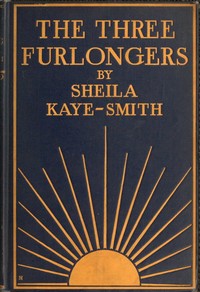
The Three Furlongers — Edition Insights
6
1
Project Gutenberg
2017
England -- Fiction; Siblings -- Fiction; Man-woman relationships -- Fiction; Ex-convicts -- Fiction
Readers of public-domain and historical texts
Project Gutenberg digital edition
en
Edition facts
Words: 73,867
Reading time: 322 min
Text sections: 8
Source:
Project Gutenberg record #56161
Sheila Kaye-Smith's 1914 novel follows the Furlonger siblings in rural Sussex, where a musician's offer to study in London tests family bonds. The narrative shifts between domestic realism and dreamlike sequences, with precise observation of landscape and social constraint.
Editorial Edition Score
4.7/5
★★★★★
★★★★★
Calculated from edition completeness, EPUB availability, text structure and catalogue metadata. Not a user rating.
Edition quality
The novel opens with a twilight scene that maps the Furlongers' world onto the night sky: the Great Wain rising over Cansiron as a farmer's wife lights a lamp, the Pleiades reflected in the lights of Dorman's Land. This cosmic-geographic alignment establishes a pattern of observation that recurs throughout the excerpts—characters read the landscape and the heavens with equal attention. Janet Furlonger, introduced as 'immensely tall' and moving with 'grand and free' gestures, is described through her clothing (or lack of it) and her wood-nut brown complexion, details that ground her in the physical world. The prose moves between close domestic detail—lifting pot lids, watching through thick green glass—and expansive natural description, a rhythm that shapes the narrative voice.
Voice and the Weight of Description
Kaye-Smith's narrator maintains a measured, slightly ironic distance. When describing Janet's walk, the text notes that people joked she 'walked as if she were showing off beautiful clothes'—then adds that this was a joke 'for Janet's clothes were terrible.' The observation is precise, the tone dry. Physical description carries social judgment: Janet's lack of stays causes scandal 'not because her figure was bad, but because it was too good.' The prose lingers on surfaces—the 'thick green glass' of the window, the 'frosty road,' the 'flush on a spring catkin'—but does so without sentimentality. This attention to material detail creates a world that feels solid, even as the narrative later moves into dream sequences.
Shifts in Pace and Register
The excerpts show two distinct speeds. The opening chapter moves slowly, building atmosphere through accumulated sensory detail: the soup, the mist, the creeping night. Later scenes accelerate into dialogue and action. When Nigel refuses von Gleichroeder's offer, the exchange is clipped and tense: 'Well?' / 'Well?' / 'Will you accept my offer?' / 'No, thank you.' The paragraph breaks shorten, and the narrator steps back to let the characters' words carry the conflict. This shift is not abrupt but prepared for by earlier moments of tension—the 'subtle sense of hostility' that Nigel feels. The novel appears to alternate between expansive description and compressed dramatic scenes, a rhythm that mirrors the siblings' own alternation between isolation and confrontation.
Dreams as Narrative Counterpoint
Nigel's restless dreams after the refusal introduce a different register: surreal, symbolic, and emotionally direct. He dreams of playing in 'great nightmare-like halls' with impossible instruments—'one string on his violin,' an instrument 'with as many strings as a harp.' The audience dances a 'hideous rigadoon' or wears a single 'dark, florid face that leers.' These images are more exaggerated than anything in the waking scenes, yet they emerge from the same concerns: ambition, inadequacy, the pressure of family. The dream of playing 'I Dreamt I Dwelt in Marble Halls' merges with the presence of Tony Strife, and the music becomes 'celestial, rarefied, wistful.' The dream ends with Len and Janey 'huddled together' in the front row, staring up. The dreamwork condenses the novel's tensions into a single, vivid scene.
Readers should attend to how Kaye-Smith uses the natural world not as backdrop but as a system of correspondences: the stars mirror the lamps, the woods hold the boundaries of three counties. The narrative voice shifts between close observation and ironic commentary, and the dreams offer a compressed, symbolic version of the waking conflicts. These elements together create a novel that is both firmly placed in its Sussex landscape and attentive to the inner lives of its characters.
Reader reflection
How did this book work for you?
Your answers remain private and are stored only in this browser.
Your progress
0
/
10
2
What was your overall reaction to the book?
3
Would you recommend this book to another reader?
4
How easy was the book to follow?
5
How strong was your personal connection to the text?
6
Could you follow the author’s main argument?
7
How useful were the ideas in this book?
8
Which part made the strongest impression?
9
What did this book teach you most?
10