1

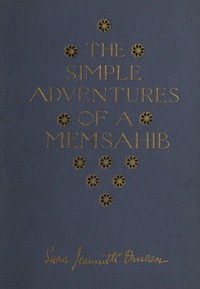
The Simple Adventures of a Memsahib — Background and Themes
5
2
Project Gutenberg
2018
India -- History -- British occupation, 1765-1947 -- Fiction; British -- India -- Fiction; Women -- India -- Fiction; India -- Social life and customs -- 19th century -- Fiction
Readers of public-domain and historical texts
Project Gutenberg digital edition
en
Edition facts
Words: 89,924
Reading time: 391 min
Text sections: 30
Source:
Project Gutenberg record #56513
An editorial note examining Sara Jeannette Duncan's use of ironic diction, observational detail, and narrative voice in her 1893 novel about a British woman's domestic life in colonial Calcutta.
Editorial Edition Score
4.9/5
★★★★★
★★★★★
Calculated from edition completeness, EPUB availability, text structure and catalogue metadata. Not a user rating.
Edition quality
Sara Jeannette Duncan's The Simple Adventures of a Memsahib (1893) opens a window onto the daily life of a British woman in colonial Calcutta through a narrator who is both inside and outside the scene. The novel's title itself carries a wry note: the word "simple" is immediately undercut by the layered social codes and physical discomforts that Helen Browne encounters. Duncan's prose is marked by a detached, ironic tone that observes the absurdities of Anglo-Indian society without sentimentalizing them. The narrative voice frequently shifts between Helen's limited perspective and a more knowing, sardonic commentary, creating a tension between the protagonist's naivety and the reader's broader understanding.
Diction and the Ironic Register
Duncan's word choices consistently signal a critical distance. When describing the bustee adjacent to the Brownes' home, she writes that it "is not necessary to explain that a bustee is an unsavoury place, the word has a taste and a smell of its own." The phrase "taste and a smell of its own" treats language as sensory experience, while the mock-scholarly disclaimer "not necessary to explain" pretends to spare the reader while actually delivering a sharp judgment. Elsewhere, the narrator refers to the "bovine nature of the fuel" consumed in the bustee, then adds, "It is impossible to put it less vulgarly than that." This self-conscious apology for bluntness is a recurring tactic: Duncan uses polite euphemism to draw attention to what it conceals. The effect is a voice that appears decorous but is in fact persistently satirical.
Observation of Domestic Space
The novel's descriptive passages are anchored in specific, unglamorous details. Helen's dressing-room window overlooks the bustee, and Duncan inventories what she sees: "a young papoia tree flourished in a corner of the roof," "various forms of vegetables fringed it," and "the daily promenade of the family cock." The catalogue continues with the goat that "took the air there" and the babies "uniformly dressed in a string." These observations are precise and unadorned, yet they accumulate to create a vivid sense of proximity and difference. The narrator notes that the babies "made marvels in mud, just as children who wear clothes do"—a comparison that quietly underscores the gap between Helen's world and theirs. Duncan does not moralize; she lets the physical details carry the weight of social commentary.
Narrative Voice and Perspective
Duncan employs a third-person narrator who frequently shifts between Helen's consciousness and a more detached, ironic viewpoint. When Helen watches the old woman cook breakfast, the narrator reports that "Helen could see what she put in it—rice, and more rice, and yellow dhol, and last of all pieces of fish." The list is simple, but the repetition of "rice" and the delayed addition of fish suggest a monotony that Helen herself may not articulate. The narrator then adds that "as she cooked the woman looked up at Helen now and then and smiled, amused that she should be interested in so poor an occupation—a memsahib!" The exclamation mark after "memsahib" is telling: it conveys the woman's amusement but also the narrator's own ironic awareness of the social hierarchy. This layered perspective allows Duncan to critique colonial attitudes without explicitly stating them.
Recurring Details and Structural Patterns
Certain motifs recur throughout the excerpts, creating a texture of everyday colonial life. The bustee appears as a constant presence, its smoke and smells infiltrating the Brownes' domestic sphere. Duncan returns to the image of the blue cloud of smoke that "hangs at set of sun" and "offends the nostrils of the very Viceroy." The hyperbole—"the very Viceroy"—is characteristic: it inflates the authority figure only to show that even he cannot control the bustee's fires. Another recurring detail is the contrast between official Calcutta and the unofficial lives of women and children. The narrator remarks that "his wife and baby go on, one might say, without official sanction of any sort; they are permitted." This dry observation about the marginal status of women recurs in the description of the bustee's inhabitants, who "fester comfortably" outside the realm of municipal concern. Duncan uses these repetitions to build a cumulative picture of a society structured by neglect and hierarchy.
Readers approaching The Simple Adventures of a Memsahib should attend to the gap between what Helen Browne notices and what the narrator implies. Duncan's irony is often subtle, embedded in word choice and juxtaposition rather than overt commentary. The novel rewards close reading of its descriptive passages, where the material details of colonial Calcutta—smoke, mud, cooking pots—carry more weight than any explicit argument. The illustrations by F. H. Townsend, which appear throughout the text, offer a visual counterpart to Duncan's observational style, though they should be considered as a separate interpretive layer.
Reader reflection
Your personal reading reflection
Build a private reading journal entry for this title.
Your progress
0
/
10
2
Was reading this book enjoyable?
3
Would you recommend this book to another reader?
4
How demanding did the text feel?
5
Is this a title worth rereading?
6
How strong was your personal connection to the text?
7
How distinctive were its ideas or approach?
8
How useful were the ideas in this book?
9
What did this book teach you most?
10