1

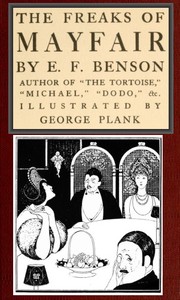
The Freaks of Mayfair — Text and Context
5
2
Project Gutenberg
2018
Humorous stories, English; Short stories, English; England -- Social life and customs -- 20th century -- Fiction
Readers of public-domain and historical texts
Project Gutenberg digital edition
en
Edition facts
Words: 44,711
Reading time: 195 min
Text sections: 5
Source:
Project Gutenberg record #57006
E. F. Benson's twelve linked satires dissect Mayfair snobbery through recurring motifs of ascent, descent, and theatrical performance, with characters trapped between aging and arrested youth.
Editorial Edition Score
4.7/5
★★★★★
★★★★★
Calculated from edition completeness, EPUB availability, text structure and catalogue metadata. Not a user rating.
Edition quality
E. F. Benson’s The Freaks of Mayfair moves through its twelve chapters like a series of social tableaux, each centered on a distinct species of snobbery. The opening story, “The Compleat Snobs,” introduces Sir Louis and Lady Mary Marigold, whose lives form “one unbroken round of pomp and successful achievement.” Benson immediately establishes a structural pattern: the narrative oscillates between present display and past acquisition, as when Lady Mary’s hobby of snobbery is compared to a stamp-collection enriched by her own specimens. This back-and-forth movement—between Berkeley Square and Marigold Park, between legendary Irish kings and contemporary peerages—sets the rhythm for the collection.
Recurring Images of Ascent and Descent
Throughout the excerpts, Benson uses vertical imagery to chart social ambition. Sir Louis playfully calls his wife “The Princess” in reference to King Arrahmedear, but the narrator notes that when she becomes a real countess, “he will drop the appellation derived from legendary kings, and call her Countess”—a shift from mythic elevation to titled fact. Later, in “The Grizzly Kittens,” Charlie Gordon’s youthful “Hermes-heels” that once carried him “on the wings of youth” are replaced by “little quick steps” that only mimic spryness. The descent is physical as well as social: Mr. Begum’s asthma makes him “tiresome and wheezy,” and the narrator describes the “toppling car” of age that now overhangs Baby Armstrong. These images of falling, climbing, and arrested motion recur across stories, binding the collection together.
Theatricality and Performance
Benson’s characters are acutely aware of themselves as performers on a Mayfair stage. Baby Armstrong, in her dialogue with Charlie Gordon, adopts a breezy, theatrical tone: “Darling, you quite understand, don’t you?” she asks, before dismissing his feelings with a flippant “Oh, do be sensible.” The narrator frames her philosophy as “flagrant,” and her refusal to acknowledge aging is itself a performance of perpetual youth. The title The Freaks of Mayfair hints at a carnival-like atmosphere, and the stories often read as vignettes in which characters play exaggerated roles—the snob, the climber, the eternal kitten. Benson’s narrator steps back to comment on these performances, as when he notes that Charlie Gordon “thinks it is the same thing” to mince as to stride, revealing the gap between self-image and reality.
Movement Between Scenes and Settings
The collection’s structure relies on rapid shifts between domestic interiors, parks, and foreign resorts. In “The Compleat Snobs,” the Marigolds are seen at Marigold Park, Homburg, and Berkeley Square within a single paragraph, each location reinforcing their social standing. Later, Baby Armstrong and Charlie Gordon ride in the Park, where she spots a rider on a chestnut horse and quips, “Is it a goat or isn’t it?”—a moment of comic observation that punctures the scene’s elegance. Benson uses these transitions to juxtapose public display with private calculation. The narrator’s voice often bridges scenes, as when he notes that “years, as impatient novelists so often inform us, passed,” drawing attention to the artificiality of time’s passage in fiction. This self-aware movement keeps the reader alert to the constructed nature of Mayfair society.
The Grizzly Kittens and Arrested Development
One of the collection’s most striking recurring motifs is the image of the “grizzly kitten”—a creature that never grows up. In the chapter of that name, Baby Armstrong and Charlie Gordon are described as having “the constitution of grizzly kittens,” a phrase that captures their refusal to mature. The narrator observes that Baby’s “sense of youth was constantly fed by her husband’s venerable habits,” so that she remains a girl even as decades pass. Charlie, too, clings to his youthful persona, but the narrator undercuts this: “He is just as light and spry as ever (except when he is troubled with lumbago).” The parenthetical exception exposes the physical reality beneath the pose. This motif of arrested development recurs across the collection, linking characters who resist the natural progression of age and status, and it gives the book a unifying thematic thread.
Readers approaching The Freaks of Mayfair will find that Benson’s satirical eye is most precise when he tracks the small gestures—a mincing step, a wheeze, a nickname dropped or retained—that betray his characters’ self-deceptions. The stories reward attention to repeated images and structural parallels rather than plot progression. Because the excerpts cover only a few chapters, the full arc of the collection remains unknown, but the patterns established in these early stories suggest a cohesive, carefully orchestrated critique of Edwardian social performance.
Reader reflection
What was your reading experience?
Capture what you thought, learned, and would like to remember.
Your progress
0
/
10
2
Was reading this book enjoyable?
3
Is this a title you would suggest to others?
4
How easy was the book to follow?
5
Did you relate to its people, ideas, or situations?
6
Could you apply anything you learned?
7
How much did the book move you?
8
Could you see yourself revisiting this book?
9
In one sentence, what did you learn?
10