1

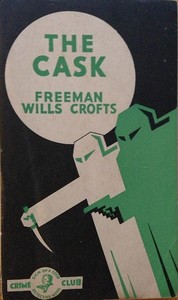
The Cask — Reading Companion
6
1
Project Gutenberg
2019
Detective and mystery stories; Police -- England -- Fiction; Murder -- Investigation -- Fiction
Readers of public-domain and historical texts
Project Gutenberg digital edition
en
Edition facts
Words: 118,413
Reading time: 515 min
Text sections: 11
Source:
Project Gutenberg record #59854
An editorial note on Freeman Wills Crofts' The Cask, examining how the author's precise diction, dialogue, and descriptive choices build a detective novel centered on a mysterious consignment and a shattered alibi.
Editorial Edition Score
4.8/5
★★★★★
★★★★★
Calculated from edition completeness, EPUB availability, text structure and catalogue metadata. Not a user rating.
Edition quality
Freeman Wills Crofts opens The Cask with a managing director scanning his inward letters and inspecting steamer returns—mundane details that anchor the story in the routines of commerce. The consignment of wines for Norton and Banks, flagged for special checking, introduces a world where paperwork and dock-office phone calls matter as much as clues. Crofts lets dialogue carry exposition: the chief clerk’s terse report, the director’s memory of “all the trouble they gave us about the last lot.” These early exchanges establish a tone of professional vigilance that will define the investigation to come.
Diction of Procedure
Crofts’s vocabulary is drawn from the language of shipping manifests, police reports, and railway timetables. Words like “consignment,” “alibi,” and “unfaltering process of analysis” appear not as flourishes but as functional tools. When Inspector Burnley says, “I think it’s a little so soon to eliminate any one from inquiry,” the phrasing is cautious, almost legalistic. This procedural diction shapes the reader’s expectation: every statement is provisional, every conclusion subject to revision. The author avoids melodramatic exclamations; even the discovery of a body in a cask is described through the same measured register used for a delayed shipment.
Dialogue as Evidence
Conversations in The Cask serve less to reveal character than to advance the chain of reasoning. The three-man council in Paris—M. Chauvet, Lefarge, and Burnley—speaks in a style that mimics a written brief: “Now, to sum up our present position.” Each speaker builds on the previous point, weighing possibilities with phrases like “that seems unquestionable” or “I confess that point of motive struck me as being very strong.” Crofts rarely uses dialogue for atmosphere or emotion; instead, it becomes a verbal reconstruction of the crime, with each line a piece of evidence tested aloud. The effect is that of a transcript from a detective conference, not a natural conversation.
Description of Physical Traces
Crofts’s descriptive passages focus on objects and their movements: the cask’s journey from Rouen to London, the timing of its unpacking, the condition of the statue inside. When the body is discovered, the narrative does not dwell on horror but on logistics—how the cask could have been opened, when the substitution occurred. The author’s eye for detail is forensic: the letter ordering the statue is examined for handwriting, the black-bearded man’s actions are traced through railway records. This emphasis on tangible evidence gives the novel a documentary texture, as if the reader is sifting through case files rather than reading fiction.
Structure of Suspicion
The novel’s structure mirrors its investigative method: each chapter presents a new piece of information that shifts suspicion from one character to another. The excerpts show a careful balancing of probabilities—Boirac’s alibi, Felix’s motive, the absence of a third party. Crofts uses the phrase “so far as we can now see” to remind the reader that knowledge is provisional. The three-part division (London, Paris, London and Paris) reinforces the idea of a case that crosses borders and requires coordination between different police forces. This structural choice turns the novel into a puzzle where geography and timing are as important as psychology.
Readers who enjoy watching detectives reason aloud will find The Cask a satisfying exercise in logical deduction. Crofts’s method rewards attention to small details—a phone call, a shipping record, a change in a suspect’s story. The novel does not offer dramatic confrontations or emotional revelations; instead, it builds its case through patient accumulation of evidence. Approach it as you would a police report: read for the facts, and let the mystery unfold through the gaps between them.
Reader reflection
How will you remember this book?
Save your reaction, strongest insight, and memorable passage.
Your progress
0
/
10
2
How much did you enjoy the reading experience?
3
Would you recommend this book to another reader?
4
How much effort did this book require?
5
Which element worked best for you?
6
How well did it match your expectations?
7
What did you think about the pace?
8
Could you see yourself revisiting this book?
9
What did this book teach you most?
10