1

The Big Blue Soldier — Reading Notes
20
3
Project Gutenberg
2019
Love stories; World War, 1914-1918 -- Veterans -- Fiction; Impersonation -- Fiction
Readers of public-domain and historical texts
Project Gutenberg digital edition
en
Edition facts
Words: 29,962
Reading time: 131 min
Text sections: 8
Source:
Project Gutenberg record #60580
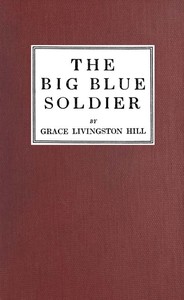
Grace Livingston Hill's 1923 novel opens with Miss Marilla Chadwick anxiously awaiting her nephew Dick's return from WWI, but a stranger in a blue uniform arrives instead. The story follows the wounded soldier Lyman Gage as he navigates mistaken identity, recovery, and romance in a small-town setting.
Editorial Edition Score
4.6/5
★★★★★
★★★★★
Calculated from edition completeness, EPUB availability, text structure and catalogue metadata. Not a user rating.
Edition quality
The novel begins not with the title character but with Miss Marilla Chadwick, who stands at her kitchen window timing the arrival of a train. Her anxious calculations—'it always takes just six minutes to get around the bend of the road'—establish a world of domestic precision and waiting. The narrative voice shifts between her fretful dialogue about pie fillings and a wry, slightly ironic tone that describes the local newspaper as offering 'fat platitudes at an ever-increasing rate.' This blend of earnest emotion and gentle satire sets the stage for a story that balances sentiment with observation.
The Opening: Waiting and Arrival
The first chapter revolves around anticipation. Miss Marilla has spent the war knitting and canteening, always thinking of her nephew Dick. When the war ends, she still speaks of him 'with bated breath and a sigh.' The reader is drawn into her vigil, only to have it disrupted by the arrival of a stranger—the big blue soldier. The text emphasizes her watchfulness and the precise timing of country life, creating a sense of place before any action occurs. The soldier's entrance is not described directly; instead, the focus remains on Miss Marilla's perspective, leaving the reader to infer his appearance and condition from her reaction.
The Soldier's Flight: A Study in Physical Strain
Later excerpts show the soldier, Lyman Gage, leaving Miss Marilla's house secretly. The prose dwells on his physical ordeal: 'the chill air met him with a challenge,' 'the wind with a tang of winter jeered at his thin uniform.' His walk to Little Silverton is measured in half-miles, each more painful than the last. The telegraph office scene reveals his desperation—he sends a collect message to Chicago for a loan, using an old house as collateral. The operator's gum-chewing indifference contrasts with his fevered urgency. This section demonstrates Hill's ability to render physical suffering and psychological strain through concrete details.
Voice and Characterization Through Dialogue
Dialogue in the excerpts reveals character economically. Miss Marilla's anxious questions about pie and her repeated references to Dick show a woman whose identity is wrapped in care for others. Mary Amber's reply—'All men like mince-pie, it’s so—sort of comprehensive, you know'—hints at a younger, more casual perspective. The soldier's note to Miss Marilla, signed 'Your Boy,' and his muttered repetition of the telegram message suggest a man clinging to purpose amid weakness. These exchanges, though brief, build a sense of distinct voices without lengthy exposition.
Setting and Atmosphere: Small-Town Life Post-War
The story is anchored in a specific time and place: post-World War I America, in the fictional towns of Springhaven and Little Silverton. Details like the local newspaper, the telegraph office, and the price of turkeys ground the narrative in everyday reality. The war's aftermath is present not in battle scenes but in the soldier's lingering illness and the community's shift from knitting to forgetting. Hill uses setting to reflect emotional states—the cold wind, the warm room, the 'crisp, cold morning'—making the environment an active participant in the soldier's journey.
Readers approaching The Big Blue Soldier for the first time should attend to how Hill builds tension through waiting and small gestures. The opening chapters reward attention to timing, dialogue, and physical detail. The soldier's identity and backstory unfold gradually, so early impressions may shift. The novel's appeal lies in its quiet observation of character under strain, not in dramatic plot twists.
Reader reflection
How did this book work for you?
Your answers remain private and are stored only in this browser.
Your progress
0
/
10
2
How much did you enjoy the reading experience?
3
Would you encourage someone else to read it?
4
Did the language feel accessible?
5
How distinctive were its ideas or approach?
6
How did the reading compare with what you expected?
7
Is this a title worth rereading?
8
What was its emotional impact?
9
What did this book teach you most?
10