1

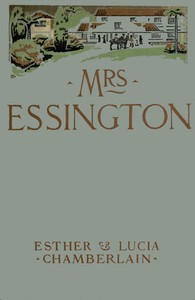
Mrs. Essington: The Romance of a House-party — Themes and Context
5
2
Project Gutenberg
2018
Country homes -- Fiction; Man-woman relationships -- Fiction; California -- Social life and customs -- Fiction
Readers of public-domain and historical texts
Project Gutenberg digital edition
en
Edition facts
Words: 39,745
Reading time: 173 min
Text sections: 16
Source:
Project Gutenberg record #56705
An editorial note on the language and narrative voice in Esther and Lucia Chamberlain's 1905 novel, focusing on how dialogue, gesture, and pacing convey tension among a house-party in California.
Editorial Edition Score
4.7/5
★★★★★
★★★★★
Calculated from edition completeness, EPUB availability, text structure and catalogue metadata. Not a user rating.
Edition quality
The novel opens with a young man and a woman in a train car, their conversation punctuated by the racket of wheels and the flat blue-green of onion fields. The woman's profile smile and the man's easy fashion establish a dynamic of intimacy and evasion. The narrative voice shifts between close third-person perspectives, often lingering on physical details—the supple bend of a throat, the cool gray light of eyes—to suggest unspoken currents. This attention to gesture and setting, rather than direct exposition, sets the tone for a story where what is left unsaid drives the plot.
Dialogue as Concealment
The opening exchange between the young man and the woman is a model of oblique communication. He presses her about her reasons for visiting the Budds, but she deflects with a smile and a vague reply: “I’m going—for the same reason that you are.” The narrative withholds the full context, forcing the reader to infer from tone and gesture. Later, Cissy’s manipulations are revealed through reported speech and indirect discourse: “It was Cissy who clapped on the appellation. It was Cissy who helped her to a conclusion.” The authors use dialogue not to clarify but to obscure, layering characters’ intentions beneath polite exchanges. This technique creates a sense of conspiracy and misdirection, as characters speak around their true feelings.
The Weight of Physical Description
Throughout the excerpts, the narrative pauses on physical details that carry emotional weight. The woman’s “long throat” and “cool gray light of her eyes” are described as touching the man “like a harmony in music.” Such moments slow the pace, drawing attention to the body as a site of meaning. In contrast, the storm scene accelerates: “the voice of the ocean grew louder with the wilder wind, until by fall of night its pulse was in the very timbers of the house.” The shift from intimate observation to environmental tumult mirrors the characters’ rising tension. The authors use setting not as backdrop but as an active force, amplifying the psychological pressure.
Pacing and the Unfolding Crisis
The narrative alternates between compressed, dialogue-driven scenes and expansive descriptive passages. Early chapters move quickly, with rapid exchanges and minimal exposition. As the house-party gathers, the pace slows, allowing for extended interior views: “Florence read in his eagerness its double element. Her throat ached with the fullness of tears.” This variation creates a rhythm of anticipation and release. The storm chapter marks a turning point, where external chaos mirrors internal conflict. The authors control tempo through sentence length and paragraph breaks, using short, clipped sentences for urgency and longer, flowing ones for reflection. This careful modulation keeps the reader attuned to the characters’ unspoken struggles.
Readers may find it useful to attend to the novel’s silences—the moments when characters look away, smile without speaking, or let a gesture answer a question. The Chamberlains build meaning through indirection, and the narrative rewards close attention to what is withheld. The house-party setting, with its confined social space, becomes a stage for these subtle performances, where every glance and pause carries weight.
Reader reflection
Take a moment to reflect on this book
Create a short personal record of your experience with this book.
Your progress
0
/
10
2
What was your overall reaction to the book?
3
Would you encourage someone else to read it?
4
How much effort did this book require?
5
Did you relate to its people, ideas, or situations?
6
Would you read this book again?
7
What was its emotional impact?
8
Did you gain anything practical from the text?
9
What is the main idea you are taking away?
10