1

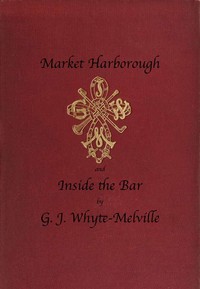
Market Harborough, and Inside the Bar — Reading Notes
4
2
Project Gutenberg
2018
Country life -- England -- Fiction; English fiction -- 19th century; Fox hunting -- Fiction
Readers of public-domain and historical texts
Project Gutenberg digital edition
en
Edition facts
Words: 126,734
Reading time: 552 min
Text sections: 39
Source:
Project Gutenberg record #56862
Whyte-Melville's novel follows Mr. Sawyer's fox-hunting adventures in the Shires, blending detailed equestrian observations with social comedy. The catalog subjects of country life and fox hunting are borne out by the excerpts, which depict hunting culture, steeplechase preparations, and the rituals of rural gentry.
Editorial Edition Score
4.9/5
★★★★★
★★★★★
Calculated from edition completeness, EPUB availability, text structure and catalogue metadata. Not a user rating.
Edition quality
Whyte-Melville opens Market Harborough with a wry observation on memory: most men dwell on a 'sunny spot' in the past, exaggerating its pleasures just as they inflate the feats of a former hunter. This framing immediately establishes the novel's tone—nostalgic yet gently mocking, attuned to the self-deceptions of its sporting characters. The catalog subjects of country life and fox hunting are fully present in the excerpts, but the text also reveals a keen interest in social performance, from the weighing-in ceremony to the banter among gentlemen riders. The steeplechase scene, with its 'cutting east wind' and 'mingled sleet and hail,' grounds the action in precise meteorological detail, while the repeated command 'Behold' parodies epic catalogues, underscoring the author's comic touch.
Hunting as Social Theater
The excerpts show that hunting in this novel is as much about social display as about sport. The steeplechase preparations are described with a comic eye for discomfort: Mr. Sawyer, 'spread-eagled' in a weighing machine, struggles to keep his spurs off wet straw while nursing saddle, bridle, and a whip with an 'elaborate and massive design.' The Honourable Crasher watches vacantly, while a professional rider named Stripes quietly works his betting-book, having 'come a hundred miles to ride Mr. Savage’s bay horse Luxury.' The dispute over whether Stripes qualifies as a 'gentleman'—dismissed because his horsemanship is too good—reveals the class tensions beneath the sport's polite surface. Whyte-Melville repeatedly contrasts the idealized past with the messy present, as when the narrator notes that 'the hounds never run nowadays as they used.'
Weather and the Physical World
The novel pays close attention to how weather shapes both action and mood. The steeplechase day is ushered in by 'frequent storms' and 'heavy showers of mingled sleet and hail,' making it 'a bad day to see; a bad day to hear; above all, a bad day to ride.' The narrator observes that at 'a few degrees above freezing' riders seek gaps in fences, while at 32° the turnpike road becomes irresistible. This meteorological precision extends to the description of the racecourse: a 'large, sloppy grass-field' with canvas booths, tramps, and card-sharpers. The physical discomfort is palpable—Mr. Sawyer's 'paper-booted, silk-capped' attire offers little protection, and the weighing tent is a 'dripping marquee' with wet straw. Whyte-Melville uses these details to ground the social comedy in a vividly realized environment, where the elements constantly intrude on human pretensions.
Voice and Narrative Structure
The narrator adopts a confiding, slightly ironic tone, addressing the reader directly with phrases like 'Behold, then' and 'Let us lift the dank, heavy sackcloth, and peep in.' This voice creates a sense of shared observation, as if the reader is being guided through the scene by a knowledgeable but amused companion. The structure of the excerpts alternates between general reflection—on memory, on weather—and specific, almost journalistic description of events. The chapter titles, such as 'One of the “Old Sort”' and 'A Leicestershire Lark,' hint at a episodic, picaresque organization. The catalog subjects of 'Country life -- England -- Fiction' and 'Fox hunting -- Fiction' are accurate, but the excerpts suggest that the novel's real interest lies in the gap between the idealized sporting life and its messy, often ridiculous reality.
Readers approaching Market Harborough should expect a work that balances technical hunting detail with social satire. Whyte-Melville's narrator is a reliable guide to the rituals of the Shires, but his eye for absurdity keeps the tone light. The excerpts offer no complete plot, but they suggest a narrative driven by set pieces—the race, the ball, the match—rather than psychological depth. Those interested in Victorian sporting fiction or the social history of fox hunting will find the novel rewarding, provided they appreciate its leisurely pace and digressive style.
Reader reflection
Take a moment to reflect on this book
Create a short personal record of your experience with this book.
Your progress
0
/
10
2
How much did you enjoy the reading experience?
3
Is this a title you would suggest to others?
4
Did the language feel accessible?
5
Is this a title worth rereading?
6
How clearly were the main ideas presented?
7
Could you apply anything you learned?
8
Did any part of the book feel personally relevant?
9
What changed or sharpened your thinking?
10