1

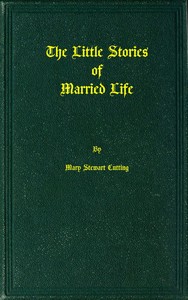
Little Stories of Married Life — Reading Notes
5
2
Project Gutenberg
2018
United States -- Social life and customs -- 19th century -- Fiction; Married people -- United States -- Fiction; Domestic fiction, American
Readers of public-domain and historical texts
Project Gutenberg digital edition
en
Edition facts
Words: 57,346
Reading time: 250 min
Text sections: 14
Source:
Project Gutenberg record #56748
Mary Stewart Cutting's 1902 collection uses precise domestic details and dialogue to explore the emotional and financial negotiations within late-19th-century American marriages, focusing on the unspoken tensions between generosity and sacrifice.
Editorial Edition Score
4.8/5
★★★★★
★★★★★
Calculated from edition completeness, EPUB availability, text structure and catalogue metadata. Not a user rating.
Edition quality
Mary Stewart Cutting opens her collection with a breakfast-table scene in which a wife reminds her husband of their wedding anniversary. The husband, hidden behind a newspaper, responds with affectionate but hurried reassurances before rushing for the train. This moment establishes a pattern: Cutting renders marital communication through small, concrete gestures—the watch furtively checked, the sleeve lining left unmended—rather than grand declarations. Across the stories, she attends to the material textures of domestic life: a worn pocketbook, a cape too shabby to wear in public, the exact cost of woolen fabric. These details do not merely decorate the narrative; they carry the emotional weight of the characters' compromises.
The Weight of a Pocketbook
In the excerpt from “Mrs. Atwood’s Outer Raiment,” Cutting builds a scene around a single object: a leather pocketbook that has “held together in spite of many years of service.” The narrator describes it as representing “the heart of a kind and generous man,” yet the wife’s response to its appearance is a “quick and blessed relief and a sharp wince.” This double reaction—relief at receiving money, pain at taking it—captures the ambivalence at the core of many of these stories. Cutting does not explain the feeling; she lets the physical object and the wife’s bodily response carry the meaning. The husband’s question—“How much will it take?”—is businesslike, but the wife’s answer spirals into calculations of yardage, linings, and the cost of having a suit made. The dialogue reveals a mind trained to stretch every dollar, even as the husband offers fifty dollars and insists she spend it on herself.
The Daughter as Witness
Cutting introduces a secondary character—the sixteen-year-old daughter Josephine—who breaks the privacy of the couple’s negotiation. Josephine rises from her corner, throws an arm around her mother, and tells her father: “She buys everything for me and the boys, and goes without herself, so that I’m ashamed to walk out in the street with her.” The daughter’s intervention shifts the scene’s emotional register. Her words are blunt, almost rude, but they articulate a truth the mother cannot say. Cutting uses the daughter to externalize the mother’s hidden sacrifice, making it visible to the husband and to the reader. The mother’s response—embarrassed, laughing, then kissing her husband—shows how quickly the family’s emotional economy reasserts itself. The daughter’s role is not to resolve the tension but to expose it, a technique Cutting repeats across the collection.
The Unspoken Promise and Its Breach
After accepting the fifty dollars, Mrs. Atwood promises to spend it all on herself. Cutting immediately undercuts this vow with a single sentence: “She knew very well that some of it would have to be spent for other needs.” The narrator then lists the small, relentless demands of a household—pads, pencils, shoestrings, lunches, postage stamps, hair ribbons, medicines, mended shoes. The list is mundane, almost boring, but that is precisely its point. Cutting refuses to dramatize the wife’s dilemma; she presents it as a routine calculation. The wife has “but fifty cents left of her allowance to last her until the end of the month, five long days away.” The precision of the numbers—fifty cents, five days—anchors the story in a specific economic reality. The wife’s guilt at breaking her promise is real, but so is the pressure of those everyday needs. Cutting leaves the contradiction unresolved, trusting the reader to feel its weight.
Dialogue as a Tool of Indirection
Throughout the excerpts, Cutting’s characters rarely say what they mean directly. In “Their Second Marriage,” the wife asks about the date; the husband answers with the day of the month, then the day of the week, before finally grasping the anniversary. The exchange is comic, but it also shows how easily domestic significance gets lost in the routines of work and habit. The husband’s relief—noted as “suspicious”—is audible in his voice when he realizes the occasion is not a crisis. In “Mrs. Atwood’s Outer Raiment,” the husband’s direct question “Will thirty dollars be enough?” cuts through the wife’s rambling about fabric widths and Cynthia Callender’s suit. Cutting uses these contrasting speech patterns—the wife’s associative, detail-laden talk versus the husband’s blunt, fact-seeking questions—to dramatize the different ways men and women in these stories navigate money, emotion, and obligation. The dialogue does not resolve misunderstandings; it enacts them.
Cutting’s stories reward attention to the small, often overlooked transactions of married life: the money counted out, the promise made and broken, the coat worn one season too many. She does not offer solutions or judgments. Instead, she builds her narratives from the precise, unglamorous details that make up a shared domestic history. Readers who approach these stories as a series of linked observations—rather than as plots leading to dramatic conclusions—will find a quietly incisive portrait of how love and money intertwine in the everyday.
Reader reflection
What was your reading experience?
Capture what you thought, learned, and would like to remember.
Your progress
0
/
10
2
What was your overall reaction to the book?
3
How likely are you to recommend this book?
4
How demanding did the text feel?
5
How useful did the reading feel?
6
How clear did the writing feel?
7
Could you see yourself revisiting this book?
8
Did any part of the book feel personally relevant?
9
Which lesson or insight stayed with you?
10