1

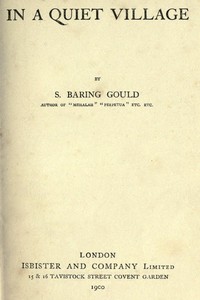
In a Quiet Village — A Closer Reading
4
1
Project Gutenberg
2018
England -- Fiction; Villages -- Fiction; Wales -- Fiction; Short stories, English
Readers of public-domain and historical texts
Project Gutenberg digital edition
en
Edition facts
Words: 68,346
Reading time: 298 min
Text sections: 8
Source:
Project Gutenberg record #56527
S. Baring-Gould's collection of village tales from England and Wales, where precise observation of character and landscape is matched by a narrative voice that shifts from wry detachment to sudden, stark tragedy.
Editorial Edition Score
4.7/5
★★★★★
★★★★★
Calculated from edition completeness, EPUB availability, text structure and catalogue metadata. Not a user rating.
Edition quality
The first story, 'Dan’l Coombe,' establishes a narrative voice that is both intimate and withholding. The tailor is introduced as 'a character indeed, and for many years a mystery as well,' but the narrator never pretends to know more than the villagers do. The prose lingers on physical details—Dan’l's weekly shave, his 'thick and very protruding eyebrows,' the two round holes in his shutters 'that were as a pair of eyes glaring down the village street'—while leaving his inner life opaque. This restraint gives the collection its distinctive texture: the reader is placed among the onlookers, not above them.
A Voice That Holds Back
Baring-Gould’s narrator often knows less than the reader suspects. In 'Dan’l Coombe,' the tailor’s secret object is withheld for thirty-five years, and the story proceeds by accumulation of external detail rather than psychological revelation. The gamekeeper’s simile—'he do lay hold on and stick to a job just as a ferret do to a rabbit'—is the closest we get to interiority. This technique recurs: characters are defined by what they do, what they say, and what others say about them, not by authorial omniscience. The effect is a kind of documentary patience, as if the narrator were taking notes from a bench by the road.
Sudden Swells of Tragedy
Alongside this measured voice, the collection can pivot abruptly into stark, almost melodramatic loss. In 'The Bride’s Well,' a girl fetching water slips on 'smooth sloping slate' and is found 'floating on the bottle-green water … like a dead white swan.' The narrator then confesses, 'I feel that it is beyond my power with pen to describe what followed'—a rare moment of rhetorical helplessness that heightens the impact. The funeral procession, with 'six girls all in white,' and the whole parish 'in floods of tears,' is rendered in a single, breathless sentence. These passages stand in deliberate contrast to the dry, observational mode of other tales, creating a rhythm of calm and rupture.
Landscape as Active Presence
The red land of 'Jack Hannaford' is described with an almost geological enthusiasm: 'the cows that consume the herbage on it have grown red as the soil itself, and if the sheep were not shorn annually they would produce fleeces of flame.' This is not mere backdrop; the soil’s fertility is a force that shapes the lives of those who live on it. Similarly, the quarry pit in 'The Bride’s Well' is a physical hazard—'the rock was slaty, inclined at a steep angle, and it was moist and slippery'—that directly causes the tragedy. Baring-Gould’s villages are not picturesque settings but active environments, their material conditions woven into the plot.
Because the excerpts are drawn from only a few of the twenty-three stories, the collection’s full range—its pacing, its variety of narratorial distance—can only be guessed at. Readers may find it useful to note how each tale establishes its own tempo: some unfold with the slow accumulation of village gossip, others with the swiftness of an accident. The tension between these modes is the book’s quiet engine.
Reader reflection
How did this book work for you?
Your answers remain private and are stored only in this browser.
Your progress
0
/
10
2
How did the book work for you overall?
3
Would you pass this book on to a friend?
4
Did the language feel accessible?
5
Could you follow the author’s main argument?
6
Was the book what you thought it would be?
7
What did you appreciate most?
8
Did the book give you something worth debating?
9
What did this book teach you most?
10