
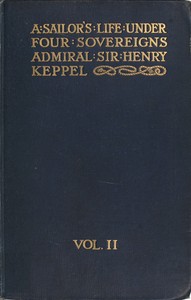
A sailor's life under four sovereigns, Volume 2 (of 3) by Sir Henry Keppel
Okay, let's set the scene. It's the mid-1800s, and the British Empire's navy is the most powerful force on the planet. Sir Henry Keppel isn't just watching from afar—he's commanding ships right in the thick of it. This volume picks up as he's plunged into the First Opium War in China. We follow his ship, the Dido, through chaotic blockades, the capture of key ports, and the sheer, overwhelming force of imperial power. Just when you catch your breath, the narrative sails to Borneo, where Keppel leads a punishing campaign against the notorious 'Sea Dayak' pirates. It's a brutal, close-quarters conflict in steamy jungles and narrow rivers, a world away from the grand naval battles.
The Story
This isn't a novel with a single plot, but a real-life adventure series. Keppel takes us from the coast of China to the islands of Southeast Asia. He describes bombarding forts, navigating political tensions with other European powers, and the daily life—and death—of sailors. A huge part of the story is his relationship with his friend and fellow officer, James Brooke, the 'White Rajah' of Sarawak. Their partnership drives much of the action in Borneo. The 'plot' is the relentless push of empire, seen through the eyes of a man who is both a loyal instrument of it and a keen observer of its costs.
Why You Should Read It
What grabbed me wasn't just the action (though there's plenty). It's Keppel's voice. He's charming, confident, and sometimes painfully of his time. Reading him is like getting an unfiltered look into the mind of the Victorian officer class. He admires courage, loathes inefficiency, and has a genuine affection for his crew. But he also rarely questions the rightness of his missions, even the morally murky ones. That tension is fascinating. You're not getting a polished, modern analysis; you're getting the raw, sometimes uncomfortable, perspective from the deck itself. It makes history feel immediate and complicated.
Final Verdict
Perfect for anyone who loves real adventure stories or wants to understand the 19th century beyond dates and treaties. If you enjoyed Patrick O'Brian's naval fiction but want the true story, this is your bridge. It's also great for readers interested in the human side of empire—the pride, the prejudice, and the personal loyalties that fueled it. A word of caution: the attitudes reflect the period, so be ready for that. But if you can engage with it on those terms, Keppel's memoirs are an absolutely gripping ride through a world of steam, sail, and shot.
You are viewing a work that belongs to the global public domain. Feel free to use it for personal or commercial purposes.
Michael Williams
4 months agoRight from the opening paragraph, the data points used to support the main thesis are quite robust. I'll be recommending this to my students and colleagues alike.
Mary Williams
1 month agoExtremely helpful for my current research project.
David Davis
8 months agoThe analytical framework presented is both innovative and robust.
Aiden Anderson
2 years agoI have to admit, the author's voice is distinct and makes complex topics easy to digest. Don't hesitate to start reading.









James Martinez
11 months agoAs a long-time follower of this subject matter, the logic behind each conclusion is easy to follow and verify. The insights gained here are worth every minute of reading.