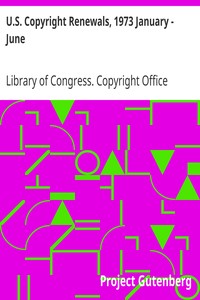
U.S. Copyright Renewals, 1973 January - June
Let's be clear: this isn't a novel. There's no protagonist, no plot twist in the traditional sense. The 'story' here is a process, a race against the clock set by old copyright law. For works published in 1945, the year 1973 was make-or-break. If a copyright holder didn't actively file for renewal during this specific six-month window, their work's exclusive rights expired. This book, published by the U.S. Copyright Office, is the official record of who showed up to that race and filed their paperwork from January to June of 1973.
The Story
Imagine a massive library where every book published in 1945 has a timer ticking above it. When the timer hits zero, the book becomes free for anyone to republish, adapt, or share. This volume is the checklist from the halfway point of that final countdown year. It lists renewals alphabetically, giving you the title, the author, the original registration number, and the claimant. The 'action' is in the names you recognize—or don't. You're scanning to see which cultural artifacts from the post-war era were deemed valuable enough to protect for another 28 years.
Why You Should Read It
I found this fascinating because it flips creativity on its head. We usually think of art as this eternal thing, but this book shows how fragile its legal protection was. It makes you ask weird, wonderful questions. Did a pulp novelist's estate care enough to renew? Did a big studio remember to renew that B-movie? This dry list becomes a lens on value, neglect, and cultural memory. It’s a reminder that a lot of what we consider our shared culture is the result of mundane administrative acts. It gives you a real sense of the hidden architecture behind the books on your shelf or the movies in your streaming queue.
Final Verdict
This is a niche masterpiece. It’s perfect for pop culture historians, writers researching the public domain, or anyone with a deep curiosity about how the legal sausage of creativity gets made. It's not for casual bedtime reading. But if you've ever wondered why some old things are freely available online and others are locked away, this is the primary source that holds part of the answer. Think of it as the ultimate 'Easter egg hunt' guide for cultural archaeologists.
No rights are reserved for this publication. Use this text in your own projects freely.
Donald Garcia
2 months agoI have to admit, the author's voice is distinct and makes complex topics easy to digest. A valuable addition to my collection.
Matthew White
1 year agoThe layout is very easy on the eyes.
Jessica Thomas
1 year agoI appreciate the objective tone and the evidence-based approach.