
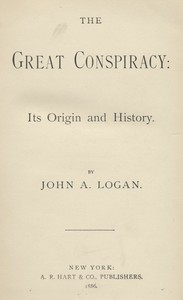
The Great Conspiracy, Volume 6 by John Alexander Logan
John Alexander Logan's 'The Great Conspiracy, Volume 6' picks up right after the nation's heart stops. President Lincoln is dead, shot at Ford's Theatre. This book is Logan's attempt to make sense of the madness that followed. He doesn't just recount the hunt for John Wilkes Booth. Instead, he methodically lays out evidence and his own firm beliefs about a broader plot. He argues that Booth was not acting alone in a crazy solo mission, but was part of a cell with a bigger goal: to assassinate not just Lincoln, but also Vice President Johnson and Secretary of State Seward, hoping to collapse the federal government in its moment of victory.
The Story
The narrative follows two main threads. First, the frantic, nationwide dragnet for Booth and his accomplices, which ended in a fiery barn in Virginia. Second, and more central to Logan's purpose, is the military tribunal that tried the captured conspirators, including Mary Surratt. Logan, writing with the passion of a veteran and politician, presents the trial's proceedings, the evidence (some solid, some hotly debated), and the swift, severe sentences handed down. The story is less about 'whodunit' and more about 'how deep did it go?' Logan is convinced it went very deep, implicating Confederate leaders in a last-ditch effort to win through terror.
Why You Should Read It
You should read this not for a balanced, modern historical analysis, but for a raw, primary-source perspective. Logan was in the arena. His writing crackles with the anger and urgency of 1865. It's history as argument, and that makes it compelling. You feel the panic of a government fearing a second revolution and the thirst for justice—or revenge. While some of his conclusions are contested by historians today, reading his case lets you experience how people who lived through it understood the tragedy. It reminds us that history's biggest events are often shrouded in immediate confusion and competing narratives.
Final Verdict
This is perfect for readers who love American history and want to go beyond the standard summaries. It's for anyone fascinated by the Civil War's messy, unresolved endings and the birth of the assassination conspiracy theory. Be prepared for a dense, detailed, and decidedly one-sided account. Think of it less as the final word and more as a fascinating, fiery opening statement from a key figure of the time. If you enjoy seeing history through the eyes of a participant who's absolutely sure of his facts, you'll find this volume absorbing.
No rights are reserved for this publication. Preserving history for future generations.
Patricia Taylor
1 year agoIt’s rare to find such a well-structured narrative nowadays, it addresses the common misconceptions in a very professional manner. I’ll definitely be revisiting some of these chapters again soon.
Matthew Lee
1 month agoI stumbled upon this title during my weekend research and the formatting on mobile devices is surprisingly crisp and clear. Highly recommended for those seeking credible information.
George Taylor
1 year agoIt took me a while to process the complex ideas here, but the argument presented in the middle section is particularly compelling. The price-to-value ratio here is simply unbeatable.
Jennifer Garcia
3 months agoBefore I started my latest project, I read this and the footnotes provide extra depth for those who want to dig deeper. This is a solid reference for both beginners and experts.



John Thomas
1 year agoWhile browsing through various academic sources, the way it handles controversial points with balance is quite professional. A mandatory read for anyone in this industry.