
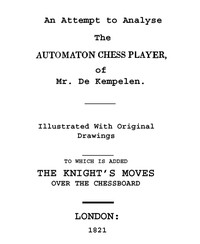
An Attempt to Analyse the Automaton Chess Player of Mr. De Kempelen by Willis
In the early 1800s, one of the world's biggest celebrities was a machine. 'The Turk,' a life-sized automaton created by Wolfgang von Kempelen, sat behind a chessboard and defeated challengers across Europe and America. Its existence sparked wild debates about technology, magic, and the limits of human ingenuity. Robert Willis, a young Cambridge scholar, wasn't buying it. His book is his methodical case file, presented to the public.
The Story
Willis doesn't tell a narrative with characters in the usual sense. The 'characters' are the automaton, its inventor, and the hidden truth. He starts by laying out the public's understanding of The Turk: a complex cabinet full of gears, with doors that opened to show (seemingly) empty machinery before a game began. Then, he acts as a literary engineer. Using published descriptions and logical deduction, he reverse-engineers the entire illusion. He explains, with clear diagrams and step-by-step reasoning, how a human operator could be concealed inside, moving from compartment to compartment as different doors were opened, and how they could see the board and control the mechanical arm. The book is the reveal of the magic trick, showing every mirror and false panel.
Why You Should Read It
The thrill here isn't in a plot twist—we know it's a hoax from the title. The joy is in watching a sharp, rational mind at work. Willis writes with a quiet confidence that's contagious. You can feel his frustration with the gullible public and his admiration for the cleverness of the deception itself. He's not angry; he's impressed by the engineering of the lie. Reading this, you get a front-row seat to a foundational moment in critical thinking. It's about looking past wonder and asking, 'But how does it actually work?' It makes you feel smarter, like you're part of the investigation.
Final Verdict
This is a perfect bite of history for curious minds. It's for people who love the 'How'd They Do That?' segment of any magic show, for fans of historical mysteries like the Voynich Manuscript, or for anyone interested in the long human conversation about technology and deception. It's not a novel; it's a forensic report, but one written with such clarity and purpose that it becomes a page-turner. If you've ever been fooled by an illusion and then delighted to learn its secret, this book is your 19th-century counterpart. A brilliant, concise demolition of a beautiful lie.
This content is free to share and distribute. Use this text in your own projects freely.
Patricia Martin
2 years agoThe clarity of the introduction set high expectations, and the critical analysis of current industry standards is very timely. This adds significant depth to my understanding of the field.
Melissa Anderson
1 year agoBeautifully written.
Emily White
8 months agoThanks for the recommendation.
Anthony Martinez
1 year agoI stumbled upon this title and the author's voice is distinct and makes complex topics easy to digest. Definitely a 5-star read.





Richard Taylor
2 months agoExceptional clarity on a very complex subject.